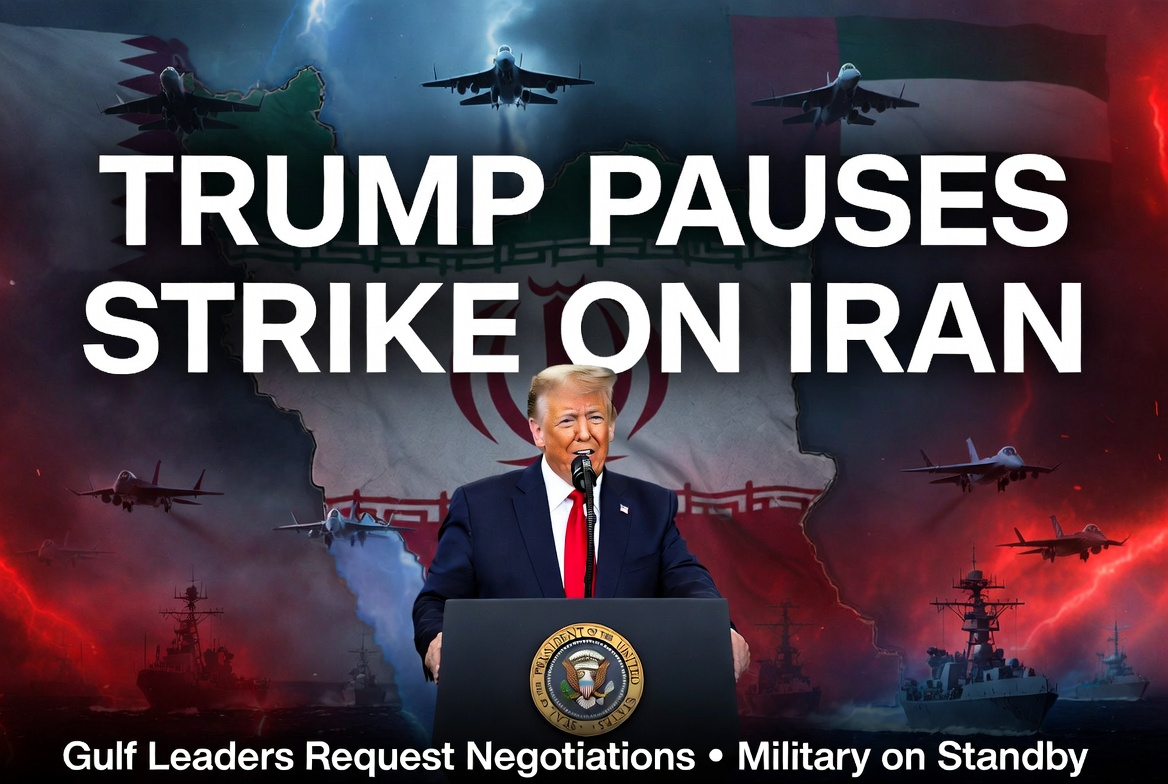
WASHINGTON D.C. – May 18, 2026 — President Donald Trump announced today that he has directed the U.S. military to stand down from a planned strike on Iran, originally scheduled for Tuesday, following urgent appeals from the leaders of Qatar, Saudi Arabia, and the United Arab Emirates.
In a statement shared via the White House Rapid Response account on X (formerly Twitter), Trump credited Qatar’s Amir Sheikh Tamim bin Hamad Al Thani, Saudi Crown Prince Mohammed bin Salman, and UAE President Mohamed bin Zayed Al Nahyan for requesting the pause, stating they believe “serious negotiations” could still yield a diplomatic resolution.
“I have instructed our military to pause the operation scheduled for tomorrow,” Trump said. He emphasized that any potential deal must guarantee Iran will not develop or acquire nuclear weapons. U.S. forces, however, remain on high alert and “fully prepared to launch a full, large-scale assault on short notice” if talks fail to produce an acceptable agreement.
The announcement comes amid heightened tensions in the region, following weeks of military posturing, prior exchanges of strikes, and concerns over Iran’s nuclear program and its impact on global energy markets, including shipping through the Strait of Hormuz.
Gulf leaders reportedly expressed confidence in a breakthrough through back-channel diplomacy. Trump’s decision reflects a pattern of using the threat of force as leverage while leaving room for negotiation, consistent with his “America First” approach that prioritizes avoiding prolonged conflicts when possible.
Mixed Reactions
The move has drawn sharp criticism from some quarters, particularly Iranian opposition voices and hawks who view repeated pauses as signs of weakness or repeated stalling tactics by Tehran. Critics on social media called it another cycle of “threats, deadlines, and delays,” with some accusing Iran of “playing the U.S. like a fiddle.”
Others defend the pause as pragmatic diplomacy, arguing it keeps pressure on Iran while exploring a potentially better outcome than military escalation.
Iranian state-affiliated responses have framed the development as a “retreat” by the U.S., though no official comment from Tehran was immediately available in mainstream reporting.
Background
This is not the first reported pause in planned U.S. actions against Iranian targets in recent months. Previous de-escalations have been tied to negotiations over nuclear issues, regional stability, and economic pressures, including oil markets. The U.S. maintains that its red line remains firm: preventing a nuclear-armed Iran.
The White House has not released a detailed timeline for the negotiations, but officials indicated military readiness has not diminished.
As developments unfold, markets and regional allies are closely watching for signs of progress or renewed escalation. Life News Agency will continue to monitor and report on this fast-moving story.
About The Author