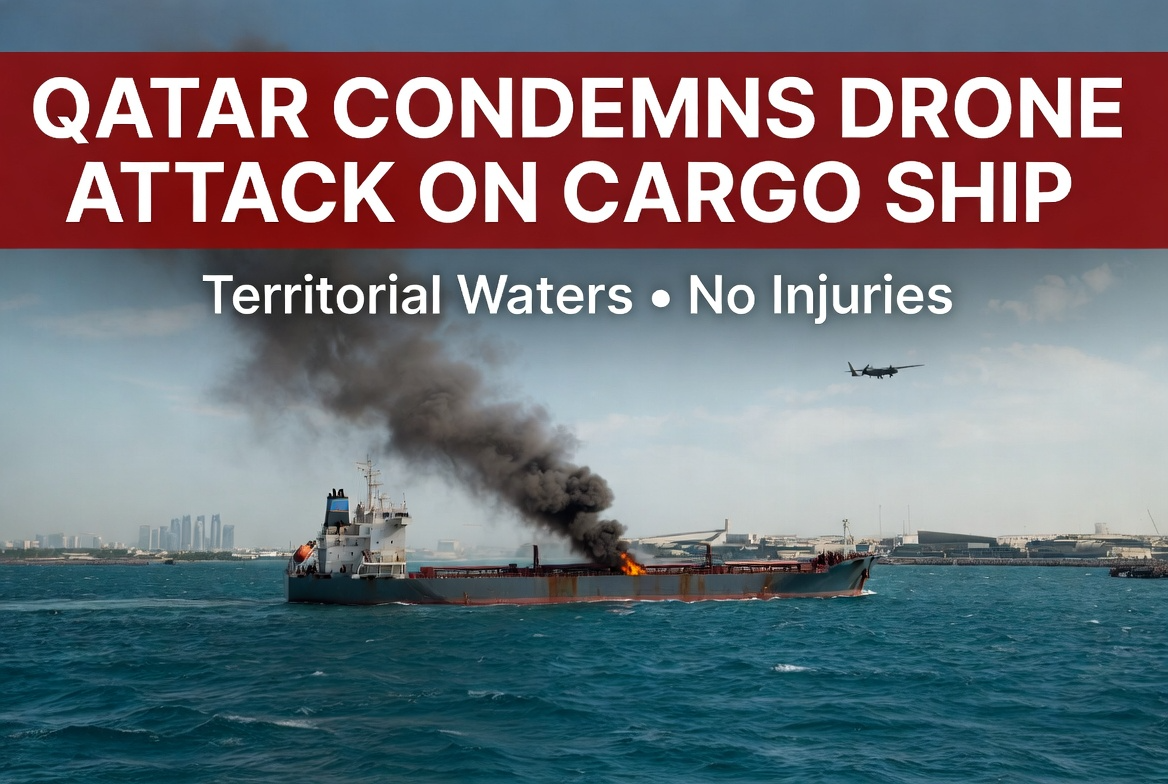
DOHA/QATAR May 10, 2026 – The State of Qatar has issued a strong condemnation of a drone attack that targeted a commercial cargo ship sailing in its territorial waters northeast of Mesaieed Port on Sunday morning.
According to statements from Qatar’s Ministry of Defence and Ministry of Foreign Affairs, the vessel — en route from Abu Dhabi — was struck by a drone, resulting in a limited fire on board. No injuries were reported, the fire was quickly contained by the crew, and the ship continued its journey toward Mesaieed Port.
In an official statement, the Ministry of Foreign Affairs described the attack as “a blatant violation of the principle of freedom of navigation and the provisions of international law.” It called the incident “a dangerous and unacceptable escalation that threatens the security and safety of maritime trade routes and vital supplies in the region.”
The ministry stressed that targeting commercial or civilian vessels — “regardless of the perpetrator” — represents a grave breach of international law and poses a direct threat to regional and international security and stability.
Qatar said it is closely monitoring developments in coordination with relevant authorities and regional and international partners. Competent authorities will carry out a full investigation to determine the circumstances of the incident and identify those responsible.
The United Kingdom Maritime Trade Operations (UKMTO) had earlier reported that a bulk carrier was hit by an unknown projectile approximately 23 nautical miles northeast of Doha, aligning with the details provided by Qatari officials.
The incident occurs amid heightened tensions across the Gulf region. On the same day, the United Arab Emirates reported shooting down two drones — which it attributed to Iran — while Kuwait said it had intercepted hostile drones in its airspace. No group has claimed responsibility for the attack on the vessel near Qatar.
Qatar reiterated its firm commitment to the security of maritime navigation and freedom of passage in international waterways, describing these as fundamental pillars of regional stability that “must not be compromised under any circumstances.”
About The Author