With nearly 60% of daily food waste deemed avoidable and seafood stocks under increasing pressure, the guidebook marks a critical shift in how the industry – and those it trains – approach sustainability.
KUALA LUMPUR, 30 APRIL 2026 – Malaysia generates approximately 16,688 tonnes of food waste daily, and nearly 60% of it is avoidable. At the same time, unsustainable sourcing practices continue to place mounting pressure on natural resources – from overfished seas to supply chains that prioritise cost over conservation.
It is against this dual backdrop that the Kuala Lumpur Convention Centre Business Events Alliance (KLCCBEA), together with WWF-Malaysia, Taylor’s University, UCSI University, launched the nation’s first Best Practices on Waste Management and Responsible Sourcing Guidebook. Practical and research-backed, the resource is designed to serve both industry practitioners and the next generation of hospitality talent – equipping them with the knowledge and tools to embed sustainability into their daily operations and decision-making.
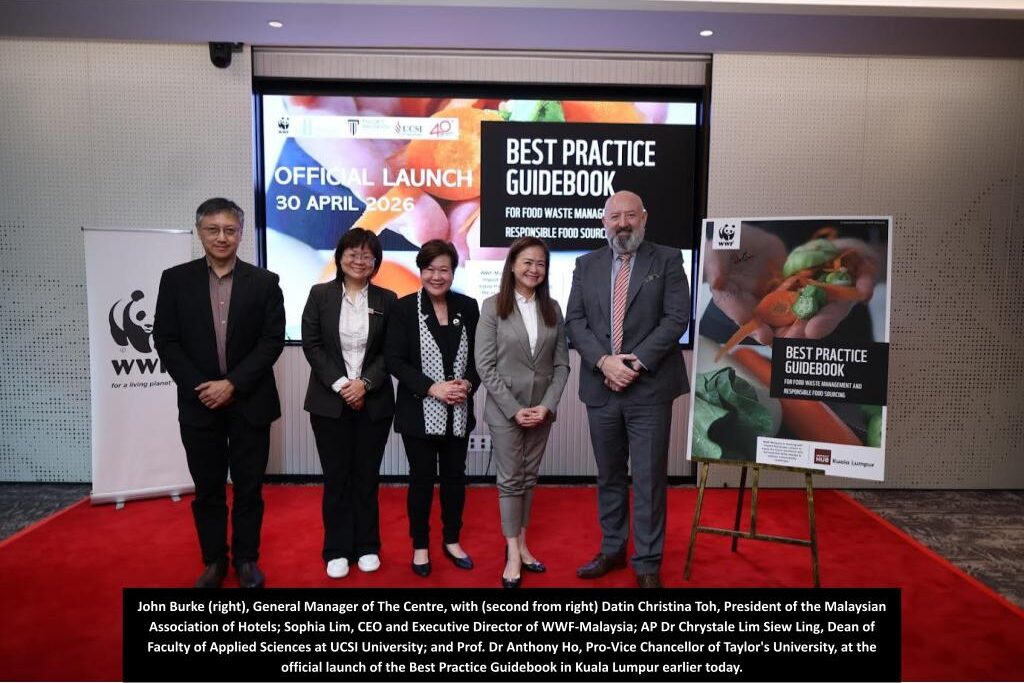
Officiated by Datin Christina Toh, President of the Malaysian Association of Hotels, the guidebook was developed through a genuine cross-sector collaboration. KLCCBEA contributed operational best practices gathered through industry workshops; Taylor’s University and UCSI University provided academic insights and curriculum integration; WWF-Malaysia oversaw its development and publication; and Impact Hub Kuala Lumpur – now known as KLBRTF World – conducted the research, analysis and content development. Sunway Resort Hotel and The Westin Kuala Lumpur also contributed practical industry perspectives that helped shape the final resource.
Speaking at the launch, John Burke, General Manager of Kuala Lumpur Convention Centre, said, “Locally, hospitality employee knowledge and attitudes towards food waste management remain only moderate – particularly in areas such as composting and internal waste audits. This guidebook was developed with both industry practitioners and educators in mind.
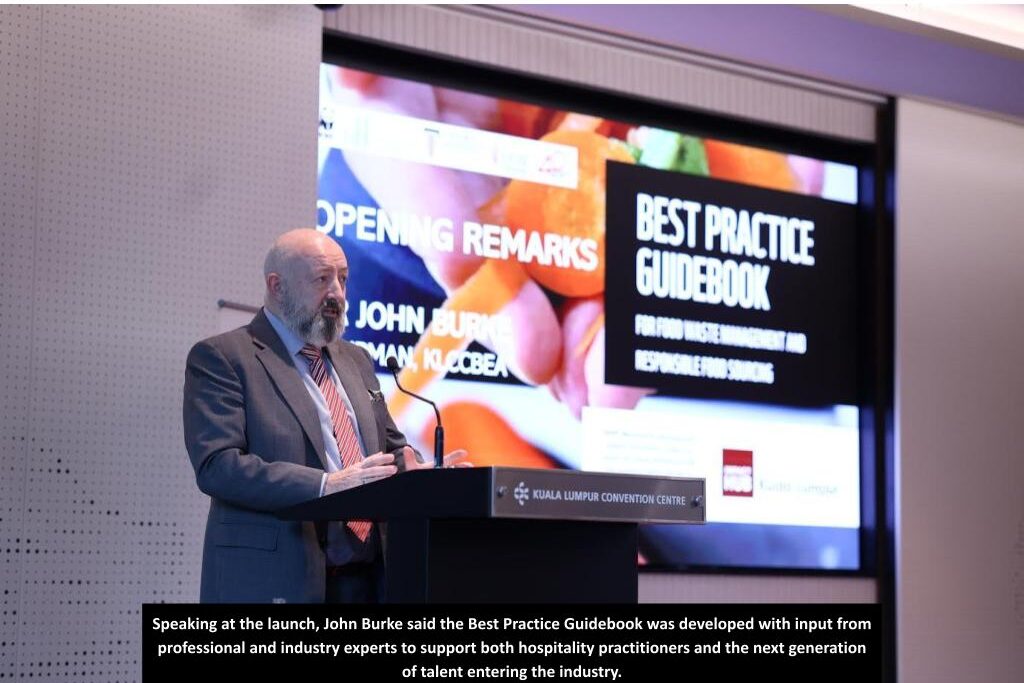
“Experienced professionals need practical tools they can apply on the ground today; at the same time, a relevant curriculum must be in place to train the next generation entering the workforce on the importance of responsible food waste management, and to conserve our finite natural resources.”
A distinguishing feature of the Guidebook is its strong emphasis on Responsible Food Sourcing (RFS) – a critical yet often overlooked dimension of hospitality sustainability. Using seafood as a key commodity case study, it illustrates how procurement decisions ripple through entire ecosystems, and provides practitioners with practical frameworks to evaluate suppliers, make informed sourcing choices, and embed sustainability criteria into purchasing policies. Responsible sourcing, the Guidebook argues, is not merely an ethical imperative – it is central to long-term business resilience and resource security.
Complementing this, the Guidebook addresses food waste reduction through Malaysia-centric case studies from hotels and restaurants that have successfully implemented sustainable food practices. It also introduces the Behaviour Centred Design (BCD) approach – a framework combining behavioural science and design thinking to help organisations identify the root causes of wasteful behaviour and implement targeted, scalable solutions.
Sophia Lim, CEO and Executive Director of WWF-Malaysia said, “Food waste accounts for an estimated 8-10% of global greenhouse gas emissions – making it a serious climate and environmental challenge. And how we source food has direct implications on biodiversity, marine ecosystems and resource security. This Guidebook equips both industry practitioners and future talent with the knowledge and practical tools needed to drive meaningful change. For WWF-Malaysia, this collaboration represents exactly the kind of systemic, multi-sector approach needed to move the needle on sustainable food systems in Malaysia.”
The Guidebook is already in active use and now serves as a key reference for the ‘Food Sociology’ and ‘Business of Hospitality, Food and Leisure Management’ modules at Taylor’s University, with UCSI University set to adopt it in due course. Early faculty feedback has been encouraging, with lecturers reporting stronger student awareness of food waste management and responsible sourcing – and a clearer sense of the role they can play as future industry professionals.
“By aligning how we train talent with how the industry operates, we create the conditions for more consistent and measurable improvements in food waste management and responsible sourcing,” added John Burke. “Our next step is to embed the guidebook’s principles into our own internal training programmes, and to work with our partners to advocate for its wider adoption – across hospitality, food and beverage, and academic institutions alike.”
The launch comes as Malaysia works towards its United Nations Sustainable Development Goal commitment to halve food waste by 2030 – a target that will require coordinated action across both industry and education. Globally, the hospitality sector wastes an estimated 100 million tonnes of food annually, while irresponsible sourcing continues to deplete biodiversity and strain supply chains. The Guidebook offers a timely and actionable framework to drive that change — from the classroom to the kitchen floor.
About The Author