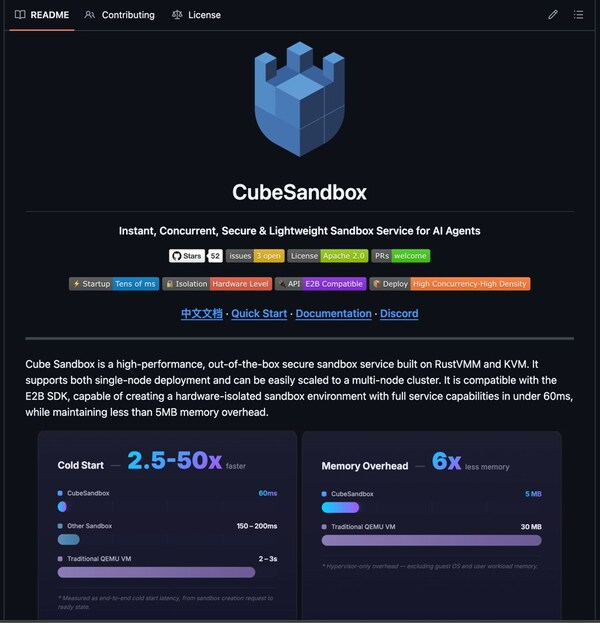
Tencent Cloud’s Cube Sandbox goes fully open source with five technical breakthroughs, providing a production-grade foundation for AI Agent deployment at industrial scale.
SHENZHEN, China, April 23, 2026 /PRNewswire/ — As AI Agent applications evolve rapidly, building an optimal underlying architecture has become one of the industry’s most pressing challenges. On April 21, 2026, Tencent Cloud officially introduced its open-sourced Cube Sandbox under Apache 2.0—not SDK-only, but the entire production-grade sandbox-as-a-service stack, battle-tested at scale and immediately deployable.
A Foundational Layer for the Agent Era
Cube is the industry’s only open-source Agent sandbox combining hardware-level isolation with sub-60ms cold start, natively supporting the OpenAI Python SDK and E2B SDK. Developers can simply redirect the runtime and migrate seamlessly. No code changes required.
This gives developers and enterprises a secure, high-performance, low-cost foundation—bringing Agents from the lab into mass production.
Performance, Security, and Stability at the Limit
Built at the hardware virtualization layer, Cube Sandbox delivers an extreme combination:
- Performance: Cold start as low as 60ms in real-world scenarios—one-third of the industry average (150ms). Minute-level scheduling of tens of thousands of sandboxes, with platform-level burst scheduling exceeding 100K instances.
- Security: A triple-layer defense architecture with millisecond-level event snapshots and state rollback, providing a critical “undo” mechanism for unpredictable Agent behavior. This feature will be launched and open-sourced once fully completed.
- Stability: Validated at ultra-large-scale production, with every headline performance number measured in live production environments.
Five Breakthroughs: A Hardware-Level Security Cockpit for Agents
Built on MicroVM architecture, Cube addresses autonomous Agent security risks: malicious code execution, data exfiltration, resource abuse, and kernel escape.
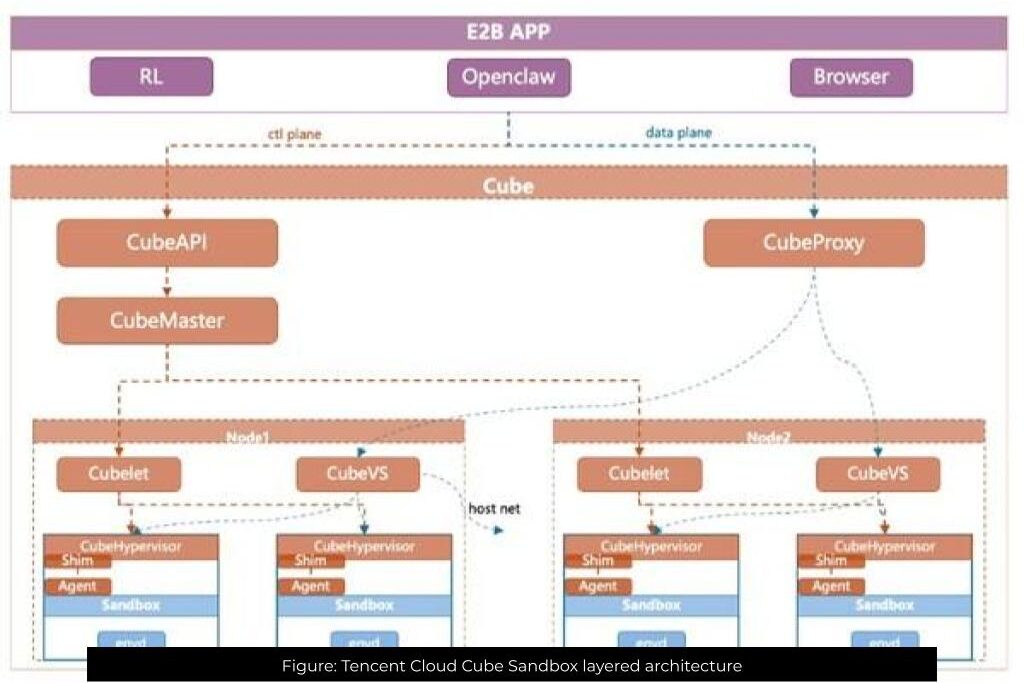
At the technical core, Cube Sandbox delivers five breakthroughs:
- Hardware-Level Isolation
Every sandbox runs a dedicated Guest OS kernel via KVM hardware virtualization—no shared kernel. “A breach in one sandbox leaves the rest untouched.”
- Sub-60ms Cold Start
Via resource pool pre-provisioning, snapshot cloning, EPT Lazy Load, and lock optimization, cold start is <60ms (avg. 67ms, P95 = 90ms at 50 concurrent)—significantly outperforming VMs, containers and peer MicroVM solutions.
- Extreme Lightweight
Per-instance memory overhead <5MB. CoW sharing, Rust-based trimming, and reflink disk sharing enable 2,000+ sandboxes on a single 96-vCPU host, with 90%+ storage savings versus traditional approaches.
- Massive Concurrent Scheduling
Distributed scheduling and bin-packing deliver platform-level burst scheduling of 100K+ instances, with P99 latency below 200ms under 100 concurrent launches on a single 96-vCPU host.
- Event-Level Snapshot Rollback
Sub-hundred-millisecond snapshots support checkpoint saving, arbitrary state rollback, and rapid forking. This capability will be released and open-sourced once development is completed.
Three User Scenarios Across the Full Agent Lifecycle
Cube Sandbox addresses the full-lifecycle needs of AI Agents—from R&D and training to application development and enterprise-scale production.
For Foundation Model Labs:
Cube tackles extreme concurrency in Agentic RL training. MiniMax runs hundreds of thousands of heterogeneous sandboxes (Linux, Windows, Android) concurrently. Cube’s image acceleration cuts storage and IO pressure; distributed scheduling delivers 100K+ instances per minute, several times faster than peer solutions.
For Agent Developers and Small-to-Medium Businesses:
No Kubernetes, no vendor lock-in—a one-click script sets up the full environment in minutes. Integration via MCP, API, SDK, or CLI requires zero rewrites to Agent code.
For Enterprise Customers:
Full private deployment keeps data within enterprise boundaries, meeting cybersecurity grading and compliance requirements. Apache 2.0 ensures commercial friendliness, full auditability, and zero dependency on foreign cloud providers.
About The Author