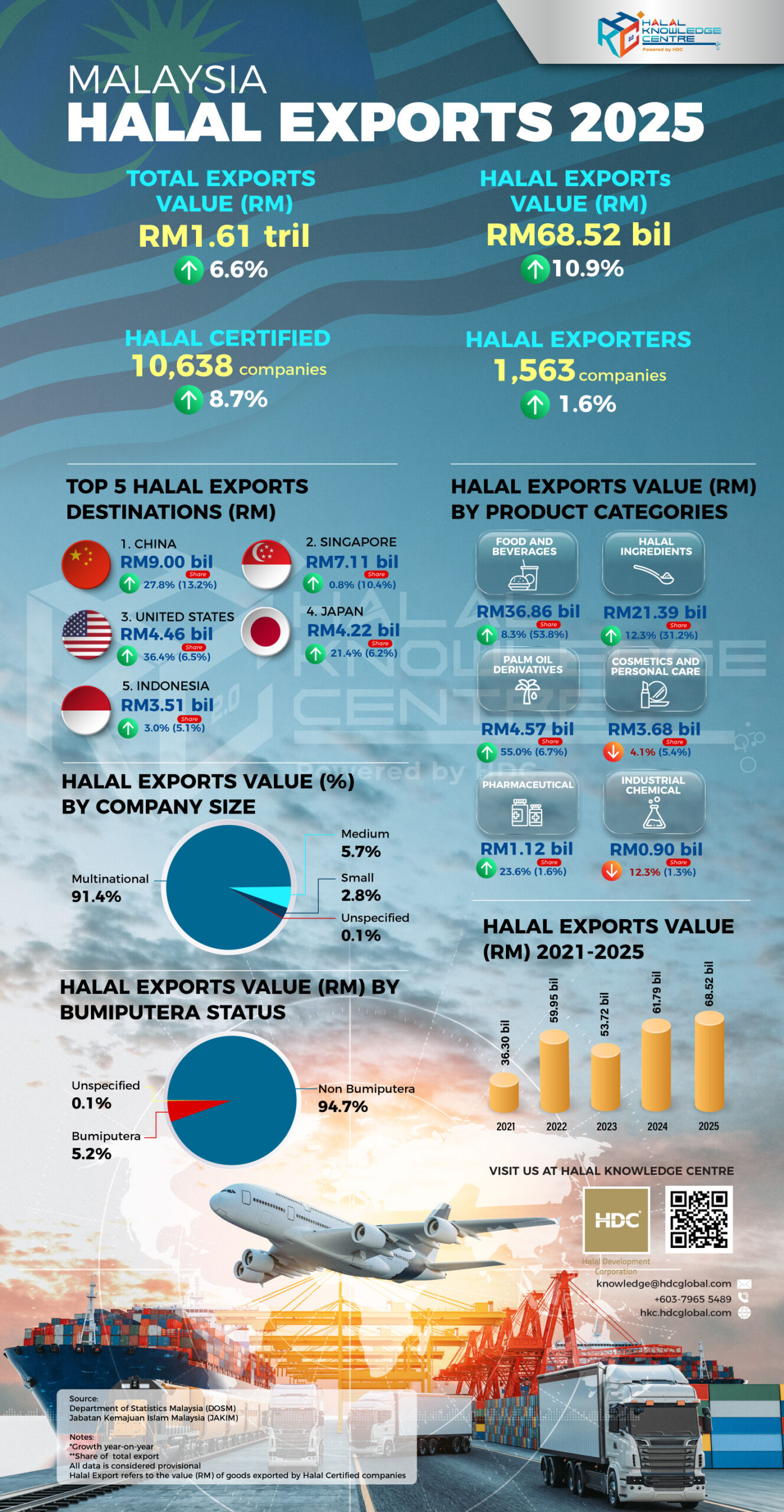
Petaling Jaya, 16 April 2026 — Halal Development Corporation Berhad (HDC) today announced Malaysia’s halal industry performance for 2025, with halal exports reaching RM68.52 billion, showing a year-on-year increase of 10.9%. This increase shows a sustained global demand and the industry’s resilience amid evolving geopolitical challenges.
Halal exports in 2025 contributed to 4.3% of total Malaysia’s overall export which is a marginal increase of 0.2% from previous year.
The export performance continues to be anchored by the food and beverages (F&B) segment, contributing approximately 53.8% (RM36.86 billion) of total halal exports, followed by Halal ingredients at RM21.39 billion (31.2%). Exports of Palm oil and derivatives valued at RM4.57 billion, experienced a significant growth of 55%.
This composition shows Malaysia’s strength in core halal consumption sectors, while highlighting ongoing opportunities to expand higher value-added segments such as pharmaceuticals and halal ingredients.
In terms of export destinations, Malaysia’s halal products continue to gain traction across diversified markets. Key export markets in 2025 include China, Singapore, The United States of America, Japan and Indonesia.
Exports to China was recorded at RM9.00 billion (13.2%) of total halal exports followed by Singapore at RM7.11 billion (10.4%). The United States of America recorded export value of RM4.46 billion (6.5%), Japan at RM4.22 billion (6.2%) and Indonesia at RM3.51 billion (5.1%). This broad market distribution echoes Malaysia’s strategic diversification beyond traditional markets, strengthening resilience against regional disruption.
In parallel, cumulative investments within Malaysia’s Halal parks continued to record steady growth, indicating sustained investor confidence in the country’s halal ecosystem, supported by strong governance, certification credibility, and integrated industry development.
“While the global halal industry remains fundamentally robust, ongoing geopolitical developments, particularly in the Middle East, may pose indirect challenges through supply chain disruptions, cost pressures, and shifts in trade dynamics,” said HDC’s Interim Chief Executive Officer, Hanisofian Alias.
HDC noted that Malaysia’s diversified export base provides a slight buffer against external impact. However, the current environment calls for greater agility, stronger supply chain resilience, and accelerated market diversification
From an industry standpoint, current global dynamics are expected to drive several structural shifts:
1. Expansion into emerging and non-traditional markets
2. Strengthening regional supply chain ecosystems
3. Increased adoption of digitalisation and traceability
4. Focus on high-value halal segments
Looking ahead, Malaysia is well-positioned to capture opportunities in a post-conflict global landscape, including supporting the rebuilding of halal supply chains and strengthening trade linkages in affected regions.
Domestically, HDC will continue to prioritise SME empowerment, export readiness, and ecosystem strengthening, including through digital platforms such as the HDC Halal Integrated Platform.
“With a strong base of halal-certified companies and growing global recognition, Malaysia’s next phase of growth will focus on developing a dynamic Halal ecosystem that will advance Malaysia’s products, integrity and know-how globally in line with the Halal Industry Master Plan 2030,” Hanisofian added.
About The Author