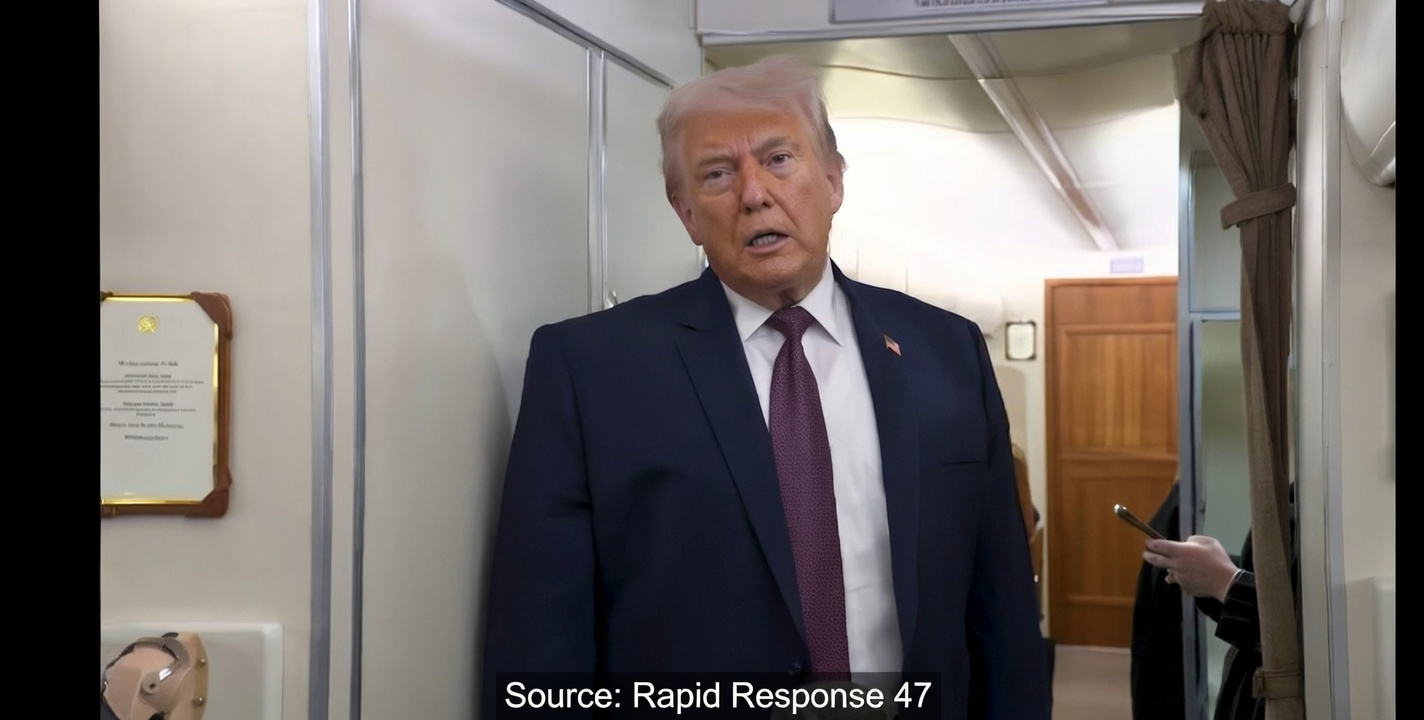
WASHINGTON D.C January 22, 2026 – In a stark escalation of U.S. posture toward the Islamic Republic, President Donald Trump announced on Thursday that a “massive fleet” of American warships is heading toward Iran as the country grapples with widespread protests and internal turmoil. Speaking to reporters aboard Air Force One en route from the World Economic Forum in Davos, Switzerland, Trump emphasized that the deployment serves as a deterrent, expressing hope that military action might not be necessary.
“We’re watching Iran. You know, we have a lot of ships going that direction just in case. We have a big flotilla going in that direction, and we’ll see what happens,” Trump stated in the video shared by the White House Rapid Response team on X. He described the force as an “armada” and reiterated, “We have a massive fleet heading in that direction, and maybe we won’t have to use it.” The president’s comments come amid reports of heightened U.S. naval activity in the Gulf region, with officials confirming that an aircraft carrier strike group and additional assets are en route to the Middle East.
Trump’s remarks also referenced recent threats he issued to Iranian leadership regarding mass executions of protesters. He claimed that his warnings prevented the hanging of 837 individuals, mostly young men, scheduled for Thursday. “An hour before these horrible things were to take place, they canceled it, and they actually said they canceled it—they didn’t postpone it. That was a good sign,” Trump said. He portrayed the averted executions as a direct result of U.S. pressure, adding that any resumption would lead to severe consequences, making previous U.S. actions against Iran “look like peanuts.”
The deployment follows weeks of intensifying protests across Iran, sparked by economic collapse, hyperinflation exceeding 40%, and chronic shortages of power and water. Demonstrations, which began in late December 2025, have spread to all 31 provinces, evolving into calls for regime change.
Protesters have chanted “Death to the Dictator” against Supreme Leader Ali Khamenei and “Javid Shah” in support of Reza Pahlavi, the exiled son of Iran’s last Shah, signaling a rejection of both the current theocracy and any return to absolute monarchy. Reports from inside Iran describe hit-and-run clashes in cities like Tehran, Mashhad, Tabriz, and Zahedan, with security forces using live fire, drones for surveillance, and internet blackouts to suppress the movement.
Iranian state media has downplayed the unrest, claiming over 3,000 deaths among protesters while organizing pro-government rallies to counter the narrative.
However, independent accounts suggest the death toll could be higher, with thousands arrested and executions threatened en masse. Human rights groups, including Amnesty International, have called for UN Security Council intervention, labeling the crackdown a “massacre.”
Iranian officials have responded defiantly, with a senior diplomat warning that Tehran’s “finger is on the trigger” in the face of U.S. threats. Trump, however, downplayed immediate conflict, stating, “I’d rather not see anything happen, but we’re watching them very closely.”
The situation has drawn international attention, with 59 U.S. Congress members urging support for a “democratic, non-nuclear republic” in Iran, emphasizing protesters’ demands for political pluralism and human rights.
As the fleet approaches, analysts warn of potential escalation in the Gulf, where U.S. and Iranian forces have clashed before.
About The Author