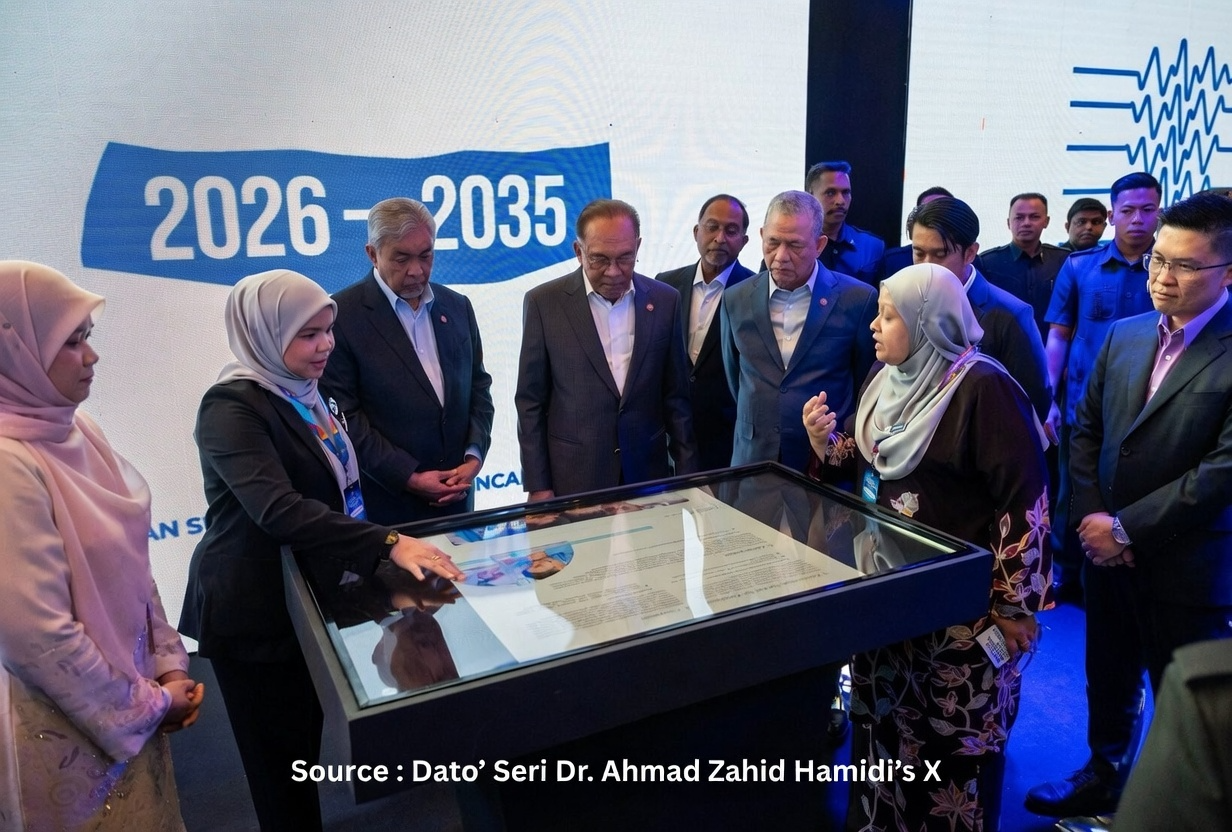
PUTRAJAYA, MALAYSIA January 20, 2026 – Deputy Prime Minister Dato’ Seri Dr Ahmad Zahid Hamidi has expressed strong support for the newly launched National Education Plan (RPN) 2026-2035, describing it as a robust foundation for the nation’s future.
The plan, unveiled by Prime Minister Dato’ Seri Anwar Ibrahim at the Putrajaya International Convention Centre (PICC) earlier today, aims to overhaul Malaysia’s education system from preschool to higher education, emphasizing equitable access, quality learning, and talent development. In a post on X (formerly Twitter), Zahid highlighted key aspects of the plan, noting that it resonates closely with the current needs of schools and universities. He praised the introduction of the Year 4 Learning Assessment starting in 2026 and the Form 3 assessment in 2027 for core subjects, which he said would provide clearer early insights into students’ mastery levels and enable timely interventions.[post:0] “This announcement feels close to the pulse of schools and universities today,” Zahid wrote.
Zahid also commended the restructuring of Form 6 and Matriculation programs under the Ministry of Higher Education (MOHE) beginning in 2027, stating it would streamline pre-university pathways to better align with higher education requirements.[post:0] Additionally, he welcomed the addition of 3,000 study places in 2026 for critical fields such as law, finance, artificial intelligence (AI), data science, language, and media, calling it a strategic move to build the nation’s future talent pool.
The deputy prime minister expressed hope that the Ministry of Education (MOE), MOHE, and the entire education ecosystem would implement this ambitious agenda meticulously and consistently to produce a generation ready to lead the country. “Insha-Allah,” he added, invoking a prayer for success.
The RPN 2026-2035, jointly led by MOE and MOHE, represents a comprehensive strategic blueprint covering the full education spectrum. Key reforms announced by Anwar include:
- Early Education Adjustments: Preschool will start at age 5, and Year 1 at age 6 from 2027, on a voluntary basis depending on parental readiness.
- Compulsory Subjects: Bahasa Melayu (BM) and History will be mandatory in all schools, including international, religious (rakyat and tahfiz), and those following the Unified Examination Certificate (UEC), to strengthen national identity and unity.
- Assessments and Interventions: The new Malaysian Learning Matrix will introduce low-pressure evaluations for Year 4 students starting October 2026 (focusing on BM, English, Mathematics, and Science) and Form 3 in 2027 (adding History), aimed at making learning easier and identifying issues early.
- Expanded Access and Inclusivity: Free education at public higher education institutions (IPTA), polytechnics, and community colleges will be extended to 10,000 students from poor backgrounds (up from 5,800) and all 3,000 students with disabilities (OKU) starting this year.
- Higher Education Reforms: Pre-university programs will shift to MOHE oversight in 2027, with guaranteed IPTA offers for STPM students achieving a 4.0 CGPA. Universities will introduce mandatory general subjects on the Malaysian Constitution and History in BM.
- Vocational and STEM Focus: Technical and Vocational Education and Training (TVET), Science, Technology, Engineering, and Mathematics (STEM), and digital pathways will be introduced earlier in schools to allow specialization.
- Infrastructure Support: RM100 million allocated for upgrading teachers’ rooms nationwide, plus directives for government-university collaboration to provide 5,000 new student accommodations.
Education Minister Fadhlina Sidek emphasized that the plan must extend beyond Putrajaya to reach grassroots levels, ensuring structured implementation. Higher Education Minister Datuk Seri Dr Zambry Abdul Kadir echoed this, stating the reforms would elevate Malaysia’s education system globally.
Reactions on X have been largely positive, with users like @jasonyew sharing clips of Anwar’s announcements and highlighting benefits for underprivileged students.Infographics from @BernamaTV detailed the plan’s components, while Selangor Menteri Besar @AmirudinShari pledged state support for the inclusive agenda.
The plan draws on the Yang di-Pertuan Agong’s call to enhance BM mastery and end linguistic debates, positioning education as central to Malaysia’s competitive edge in a global economy. Implementation reports are due by late March, with a focus on values, technology, and human development to prepare Malaysians for future challenges.
About The Author