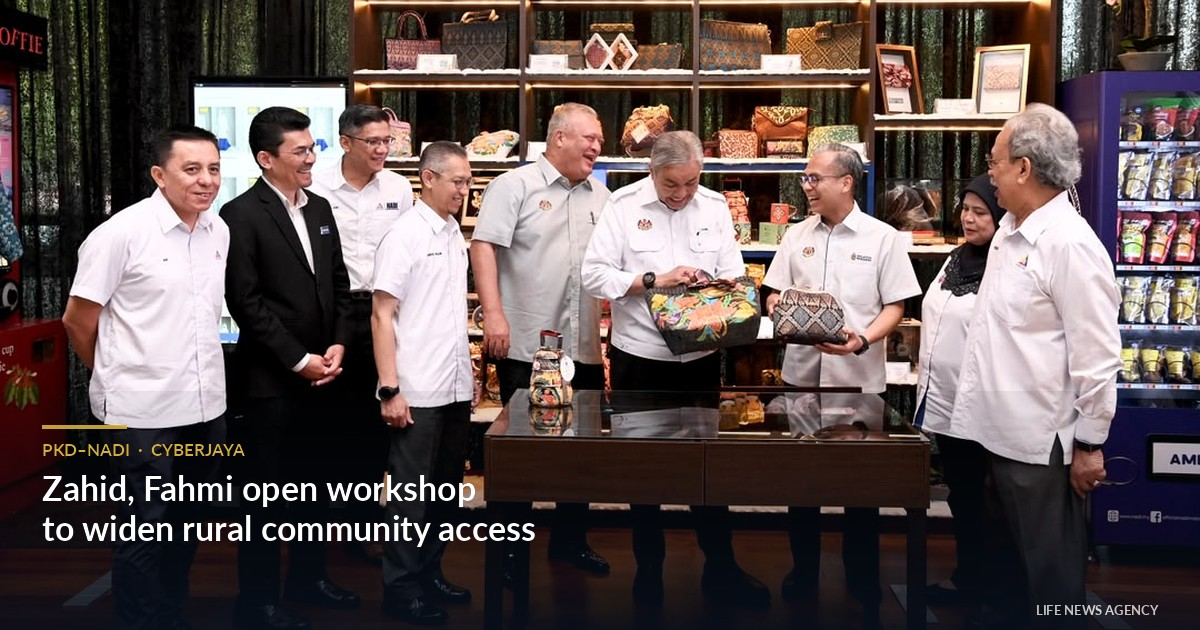
Deputy Prime Minister Datuk Seri Ahmad Zahid Hamidi and Communications Minister Datuk Seri Fahmi Fadzil visit the NADI Entrepreneurs Gallery, which gathers and promotes products by NADI entrepreneurs from across the country. The gallery provides a physical marketing and sales space for entrepreneurs while showcasing products from the NADI community.
CYBERJAYA, Sept 7 2026 — Deputy Prime Minister Datuk Seri Dr Ahmad Zahid Hamidi and Communications Minister Datuk Seri Fahmi Fadzil today attended the opening of a two-day strategic cooperation workshop aimed at aligning Rural Community Centres (PKD) and National Information Dissemination Centres (NADI).
The workshop, held through NADI, is intended to tighten coordination between the two community networks and expand public access to capacity-building, skills training, entrepreneurship and other community development programmes, particularly in rural areas.
Zahid, who is also Rural and Regional Development Minister, and Fahmi were present at the opening session of the PKD-NADI Strategic Cooperation Workshop.
The meeting brings together officials from the Ministry of Communications (KK), the Ministry of Rural and Regional Development (KKDW), the Public Service Department (JPA), the Malaysian Communications and Multimedia Commission (MCMC) and other related agencies.
MCMC said the exercise is in line with a whole-of-government approach to reduce overlapping functions, make better use of existing resources and improve the reach of public services and community programmes.
Participants are expected to examine issues, challenges and proposals for a more effective PKD-NADI collaboration model. This includes sharing facilities, coordinating community programmes and strengthening service delivery at the grassroots.
The outcomes will be used by both ministries to refine an implementation framework and follow-up measures.
Malaysia currently has 1,099 NADI centres under the Communications Ministry and 191 PKDs under KKDW. Both networks play a key role in community development and empowerment, especially among rural residents.
NADI now has more than two million users and runs the NADI Smart Services Programme in five main areas: entrepreneurship, lifelong learning, self-wellbeing, awareness and government initiatives.
PKDs, meanwhile, have carried out more than 29,000 programmes over the past five years, benefiting more than 746,000 rural residents.
The NADI model received international recognition through the World Summit on the Information Society (WSIS) Prizes 2025 in the Capacity Building category. In March 2026, it was also designated the world’s 16th Digital Transformation Centre (DTC) by the International Telecommunication Union (ITU).
MCMC said the recognitions reflect NADI’s approach to capacity building and community digital transformation, and provide a foundation for the proposed PKD-NADI cooperation model.
— MCMC / LNA MY
About The Author