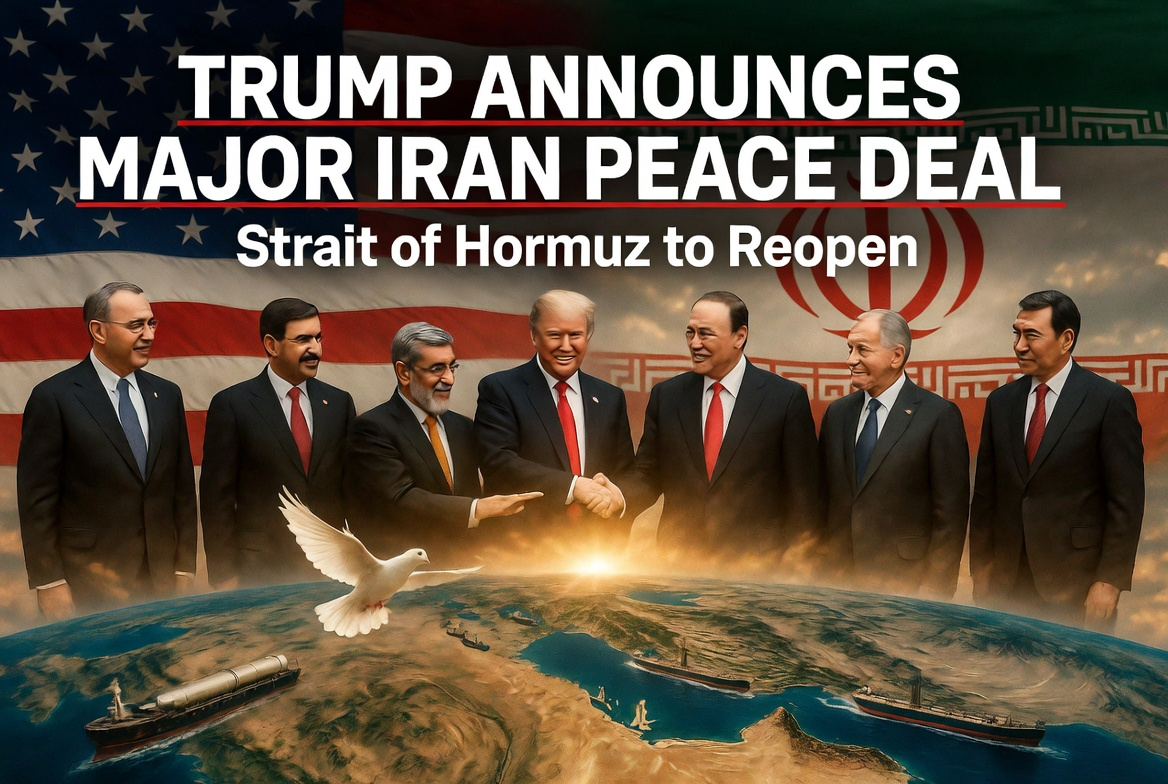
WASHINGTON, D.C. May 23, 2026 — President Donald J. Trump announced on Saturday that the United States has largely negotiated a peace framework with Iran and several key Middle Eastern and regional leaders, paving the way for a Memorandum of Understanding (MoU) aimed at ending hostilities and reopening the critical Strait of Hormuz.
In a post from the White House, Trump stated: “An Agreement has been largely negotiated, subject to finalization between the United States of America, the Islamic Republic of Iran, and the various other Countries, as listed…”
The announcement follows a productive call with leaders from Saudi Arabia, UAE, Qatar, Pakistan, Turkey, Egypt, Jordan, and Bahrain. The discussions focused on establishing a broader framework for peace in the region.
A central element of the emerging deal is the reopening of the Strait of Hormuz, a vital chokepoint responsible for roughly 20% of global oil shipments. The strait has been a flashpoint amid recent tensions, with disruptions affecting international energy markets. Reopening it is expected to ease pressure on oil prices and global supply chains.
Trump also confirmed a separate call with Israeli Prime Minister Benjamin Netanyahu to discuss the agreement’s details and ensure alignment on regional security concerns.
The development comes amid ongoing U.S.-Iran negotiations that have stretched through 2025 and into 2026. Previous efforts included attempts to manage the strait amid blockades and military posturing. The proposed MoU reportedly serves as a framework for further talks, potentially covering de-escalation, sanctions relief, and longer-term issues like Iran’s nuclear program, though core disputes remain unresolved.
Sources indicate the memorandum could include phased steps: immediate maritime access improvements in exchange for eased restrictions, with deeper discussions on uranium stockpiles and inspections to follow in the coming weeks.
The announcement has drawn mixed responses:
- Supporters view it as a pragmatic step toward stability and economic relief.
- Critics, including some Iranian opposition voices and regional hawks, express skepticism about Iran’s reliability in honoring agreements and concerns over insufficient pressure on the regime’s nuclear ambitions and proxy activities.
White House officials described the talks as constructive, with Trump indicating the chances of finalizing a deal or needing further action remain fluid.
This marks a significant potential turning point in U.S.-Iran relations, building on Trump’s history of unconventional diplomacy in the Middle East. Further details are expected as negotiations move toward formalization.
Life News Agency will continue monitoring developments and provide updates as more information emerges from official channels.
About The Author