WASHINGTON D.C. February 22, 2026 – In a swift response to a Supreme Court ruling that invalidated President Donald Trump’s use of emergency powers for imposing sweeping tariffs, the administration has announced a new 15% global tariff on imports under a different legal authority. Treasury Secretary Scott Bessent emphasized that this shift will maintain tariff revenue levels, ensuring continuity in the president’s trade agenda.
The Supreme Court, in a 6-3 decision on February 20, 2026, struck down tariffs enacted under the International Emergency Economic Powers Act (IEEPA), deeming them an overreach of executive authority reserved for genuine national emergencies. Following the ruling, Trump initially imposed a 10% global tariff via Section 122 of the 1974 Trade Act, which permits temporary levies up to 15% for up to 150 days to address balance-of-payments issues. The next day, on February 21, the president escalated it to the maximum 15% rate “effective immediately,” criticizing the court’s decision as “ridiculous, poorly written, and extraordinarily anti-American.”
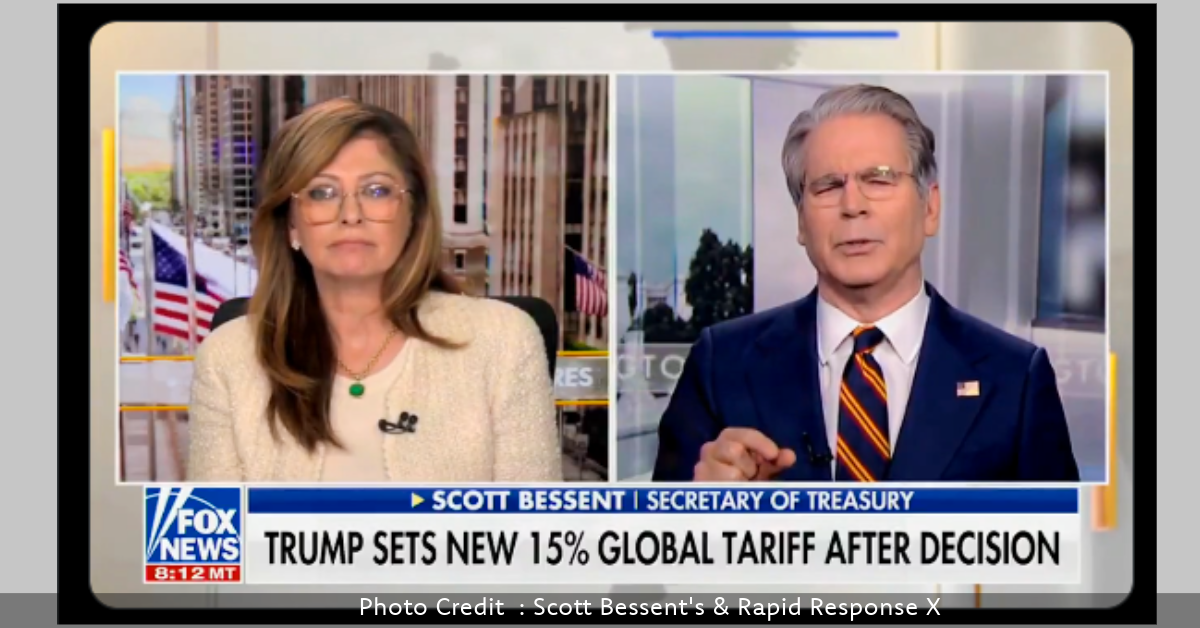
In an appearance on Fox News, Bessent stated, “The IEEPA tariffs are going to be replaced in 3 days with the Section 122, and I can tell you, at Treasury… tariff revenue will be unchanged this year, and will be unchanged in the future.” This assurance comes amid concerns over potential revenue shortfalls, with Bessent noting that the administration will leverage other validated authorities like Sections 232 and 301 to offset losses from the invalidated duties.
The new tariff applies non-discriminatorily to most imports, excluding certain critical minerals, metals, and energy products, and builds atop existing levies on items like steel and aluminum. Countries party to agreements like the USMCA (United States-Mexico-Canada Agreement) may retain exemptions if compliant, but the blanket approach marks a departure from the targeted, higher-rate IEEPA tariffs that ranged from 15-50% on specific nations.
Economic analysts have mixed views on the move. Some see it as a temporary de-escalation, given Section 122’s 150-day limit and the need for congressional extension, potentially pressuring trading partners into negotiations. Others warn of inflationary pressures on consumers and supply chain disruptions, with California Governor Gavin Newsom describing the president’s actions as “flailing” in the wake of the court defeat.
Internationally, the tariffs have sparked reactions. In India, discussions around reciprocal adjustments have led to speculation of diversified trade deals to mitigate impacts, with some observers noting preferential treatments for sectors like pharmaceuticals and auto components. China, previously facing steeper duties, may view the uniform 15% as a relative relief, though existing Section 301 tariffs remain in place.
Bessent has deferred questions on refunds for duties paid under the now-invalid IEEPA to lower courts, potentially involving billions in reimbursements to importers like major retailers. The administration maintains that overall policy remains unchanged, with Trade Representative Jamieson Greer affirming persistence in bilateral agreements with over 20 countries.
As markets digest the changes, the White House’s rapid pivot underscores Trump’s commitment to his “America First” trade stance, even as legal constraints force adaptations. The coming months will test whether Congress extends the Section 122 tariffs or if new challenges arise.
About The Author