By Rhea Lareina Richard and Dr. Gan Yee Chin
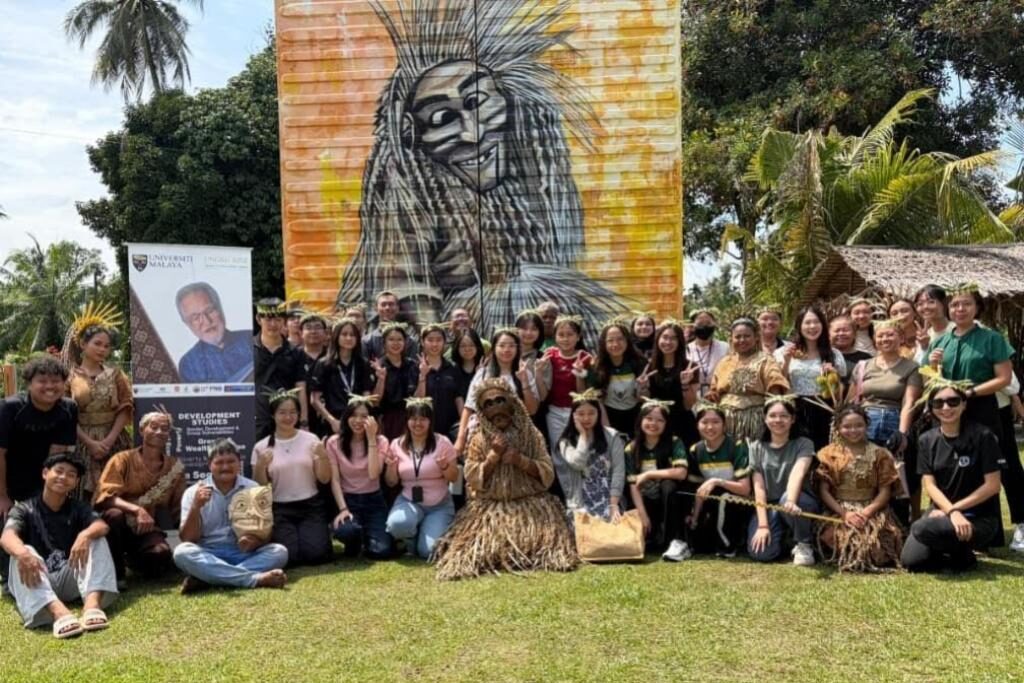
Modernisation may have reshaped societies across the globe, but it has not erased cultural values. Instead, it has revealed an important truth: there is power in safekeeping. This became evident during an educational visit to the Orang Asli Craft Centre in Carey Island, Selangor, on Friday, January 9, 2026. Rhea, a student and member of an Indigenous community, reflected that having previously engaged with the Orang Asli Temuan community, she approached this visit with great anticipation and a strong desire to deepen her understanding of Indigenous heritage. Together, we experienced firsthand how cultural knowledge is actively preserved and shared.
Upon arrival, we were warmly welcomed by members of the Mah Meri community, who placed tempoks on our heads as a gesture of hospitality. The centre’s earthy landscape offered a refreshing contrast to Kuala Lumpur’s urban environment, and informal exchanges quickly fostered connections between visitors and hosts. Then, students were able to observe the making of handicrafts from nipah leaves and attended a Jo’oh dance performance featuring a masked frontman and three young dancers. The performers also invited participants to join, allowing visitors to immerse themselves directly into the experience.
The programme continued with an interview session with one of the centre’s master craftsmen, Mr. Kemi Khamis, who demonstrated wood carving while explaining the symbolic nature of Mah Meri craftsmanship. He emphasised that these artefacts are not merely decorative but carry spiritual and cultural significance, and that not all members of the community are permitted to produce them. Students were also allowed to witness a traditional Mah Meri wedding demonstration involving two students, and to try the sumpit, offering further insight into the Mah Meri’s cultural practices.
The most meaningful learning experience emerged during independent site exploration, when small groups engaged directly with the Mah Meri community members. We had conversations with several women that highlighted the centrality of language in sustaining cultural identity. They spoke about the challenges of preserving their mother tongue, particularly as younger generations increasingly favour Bahasa Melayu and English, which are the dominant languages in education, daily interaction, and online spaces. This linguistic shift reflects a broader tension between modernisation and cultural continuity, where increased exposure to mainstream languages inadvertently places Indigenous languages at risk.
Ultimately, dynamics highlight why safekeeping matters. Language loss does not occur in isolation; it often signals a gradual erosion of traditions, values, and collective memory. As scholars, this highlights our responsibility to advocate for preservation efforts that extend beyond documentation toward meaningful community engagement and empowerment. Safekeeping is not resistance to progress, but recognition that development must coexist with cultural continuity.
While contemporary society prioritises adaptation, it is equally vital for Malaysians to uphold and protect their cultural roots. This visit reaffirmed the richness of Malaysia’s diverse ethnic communities and the importance of sustaining them. Through greater public exposure, supported by education, documentation, and long-term preservation initiatives, a wider appreciation of cultures such as those of the Orang Asli can be cultivated.
Ultimately, this experience reinforced that power does not lie solely in change. It also resides in safekeeping, whether in terms of language, traditions, or identity. Amid the pace of modern life, taking time to engage with and value our surroundings allows us to recognise that preserving what matters is itself an act of strength. In remembering where we come from, we gain clarity about who we are, and in safeguarding these cultural legacies, we ensure they continue to empower generations to come.
Rhea Lareina Richard and Dr. Gan Yee Chin are from the Faculty of Languages and Linguistics, Universiti Malaya
About The Author