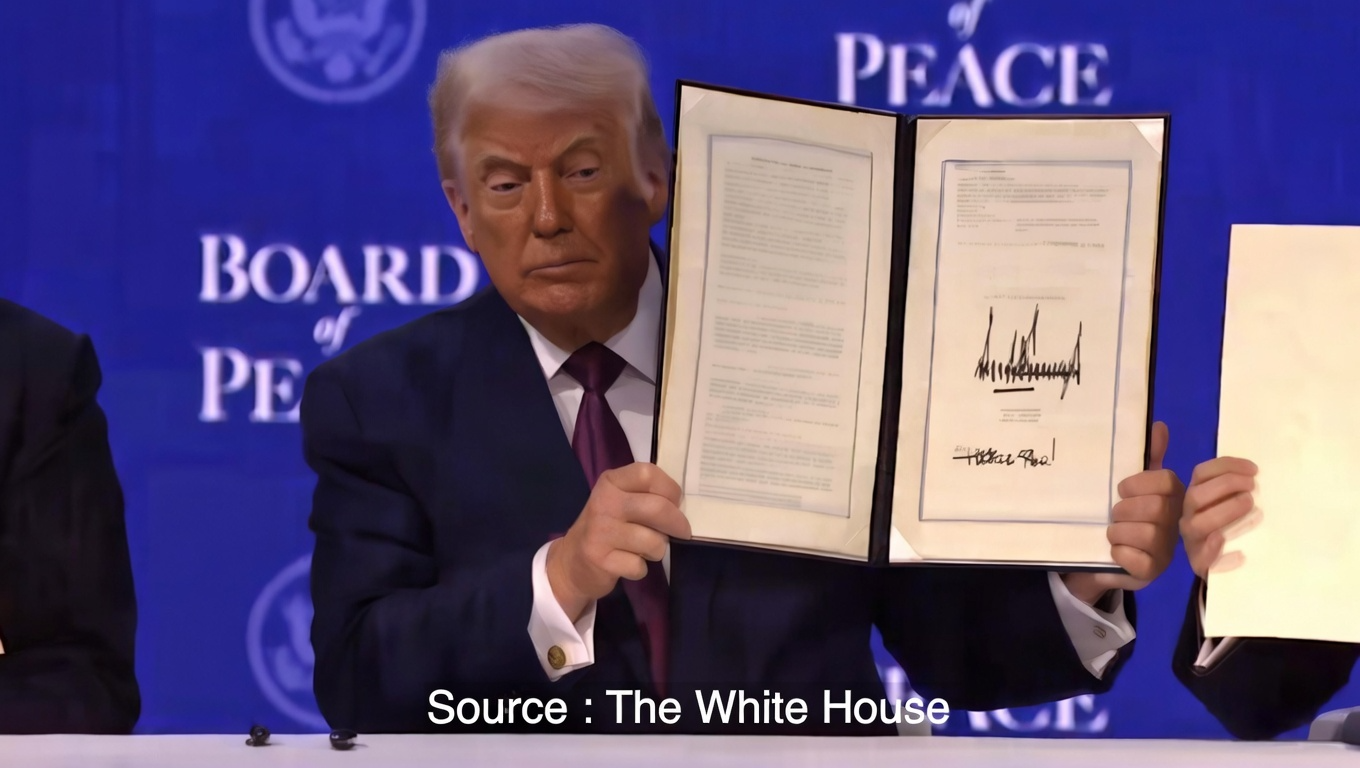
DAVOS. SWITZERLAND January 22, 2026 – In a high-profile ceremony at the World Economic Forum, President Donald J. Trump signed and ratified the charter for the Board of Peace, officially establishing it as an international organization aimed at resolving global conflicts. Trump, who will serve as the board’s chairman indefinitely, hailed the move as a step toward “peace in the world,” beginning with oversight of Gaza’s reconstruction following more than two years of conflict.
The event, attended by leaders and representatives from over 20 countries, marked the culmination of months of diplomatic efforts. The White House announced the signing via a post on X (formerly Twitter), stating: “President Donald J. Trump signs and ratifies the Board of Peace charter, officially making the Board of Peace an international organization. THE PEACE PRESIDENT.” A video accompanying the post showed Trump at the podium, penning his signature and holding up the document amid applause, with a narrator declaring, “Congratulations, President Trump. The Charter is now in full force and the Board of Peace is now an official international organization.”
Originally proposed to monitor a ceasefire and rebuild Gaza after Israel’s war with Hamas, the board’s charter expands its mandate to address broader “areas affected or threatened by conflict.” According to the full text of the charter, the organization promotes stability, peace, and governance, with no explicit mention of Gaza, suggesting potential applications to other global hotspots.
Trump emphasized collaboration with the United Nations, which endorsed the board’s creation in November 2025. “This is one of the most consequential bodies ever created,” Trump said during the ceremony, describing it as comprising “top leaders in the world” working toward global peace. He added that the board could “do pretty much whatever we want to do” in pursuit of its goals
Membership and Structure
Permanent membership requires a $1 billion contribution, which critics have labeled a “pay-to-play” scheme. The White House reported commitments from 59 countries, though only about 35 participated in the initial signing. Key participants include Middle Eastern nations like Saudi Arabia, the UAE, and Jordan, as well as others such as Hungary and Pakistan.
Here’s a breakdown of confirmed and interested members based on reports from multiple sources:
| Category | Countries |
| Signed/Joined | Argentina, Armenia, Azerbaijan, Bahrain, Belgium, Bulgaria, Egypt, Hungary, Indonesia, Jordan, Kazakhstan, Kosovo, Mongolia, Morocco, Pakistan, Paraguay, Qatar, Saudi Arabia, Turkey, UAE, Uzbekistan |
| Interested/Accepted Invitation | Belarus, Canada, Israel, Vietnam |
| Declined/Abstaining | France, Norway, Sweden, UK (citing concerns over potential Russian involvement) |
European allies expressed reservations, with the UK’s Foreign Secretary Yvette Cooper stating the country would not sign due to “broader issues” involving a legal treaty and possible participation by Russian President Vladimir Putin.
About The Author