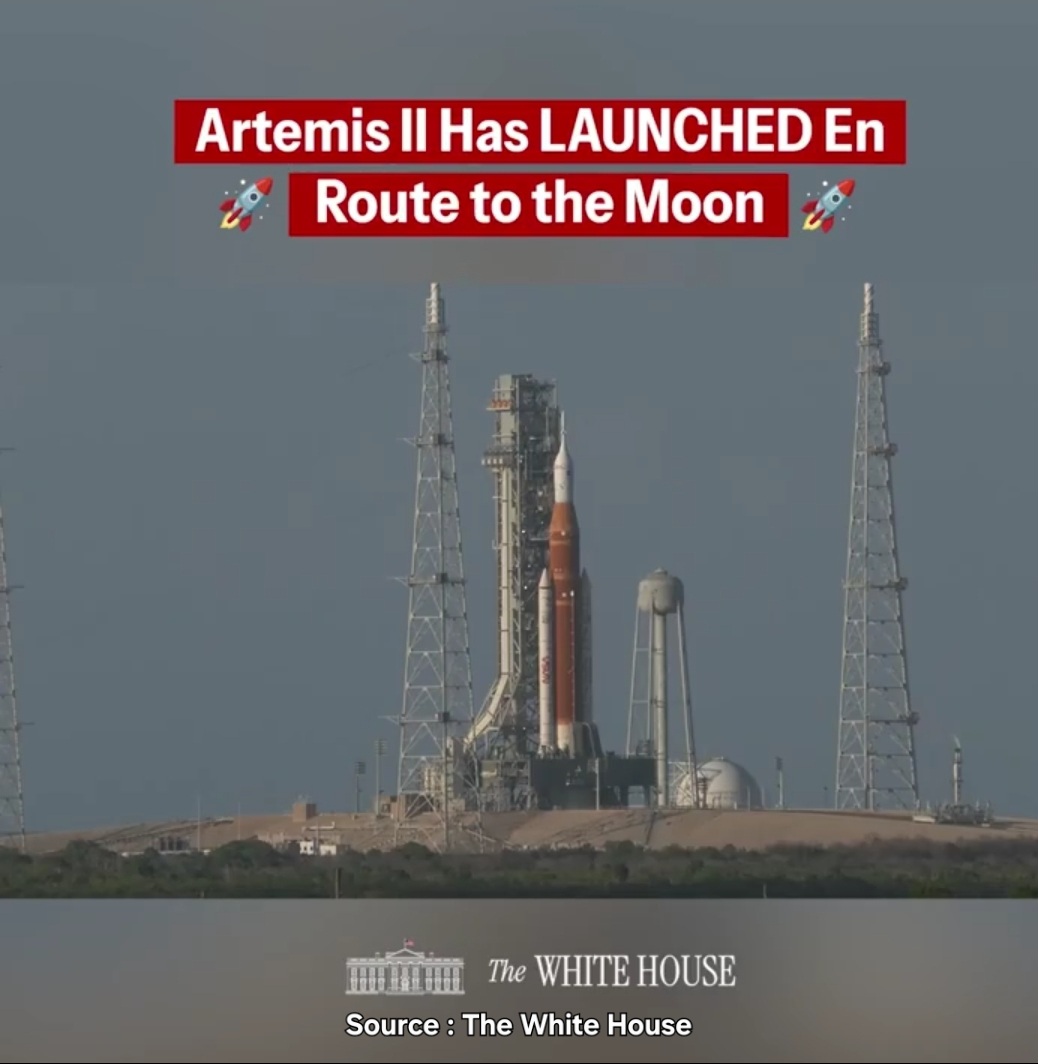
FLORIDA April 1, 2026 – In a landmark achievement for space exploration, NASA’s Artemis II mission lifted off successfully on April 1, 2026, from Launch Pad 39B at Kennedy Space Center in Florida. This marks the first time humans have traveled toward the Moon since Apollo 17 in 1972.
The White House shared the news moments after liftoff with the announcement:
“ARTEMIS II HAS LAUNCHED 🚀 GODSPEED. 🇺🇸”
accompanied by dramatic live footage of the powerful Space Launch System (SLS) rocket roaring into the sky.
The four-person international crew aboard the Orion spacecraft includes:
– Commander Reid Wiseman (NASA)
– Pilot Victor Glover (NASA)
– Mission Specialist Christina Koch (NASA)
– Mission Specialist Jeremy Hansen (Canadian Space Agency)
They are embarking on a roughly 10-day mission that will send them on a free-return trajectory around the Moon — the farthest any humans have ventured from Earth in more than five decades — before safely returning home.
Artemis II serves as a critical uncrewed-to-crewed test flight for NASA’s Artemis program, which aims to establish a sustainable human presence on the Moon and prepare for future missions to Mars. The successful launch follows the uncrewed Artemis I test flight and sets the stage for Artemis III, the first crewed lunar landing in the modern era.
The mission has captured global attention, with millions watching live as the SLS rocket — the most powerful ever built — propelled the crew beyond low Earth orbit. Reactions poured in across social media, with many Americans expressing national pride and offering prayers for the astronauts’ safe journey.
As the crew continues its voyage, NASA teams are monitoring systems closely. Updates will follow as Artemis II progresses toward its historic lunar flyby.
About The Author