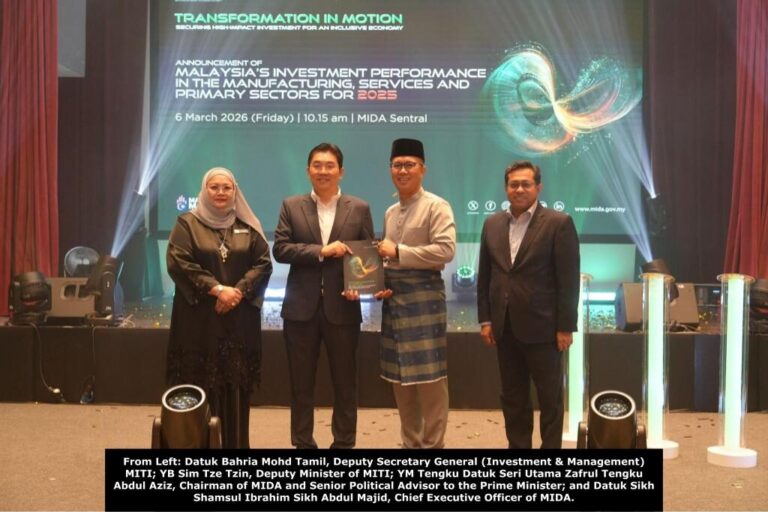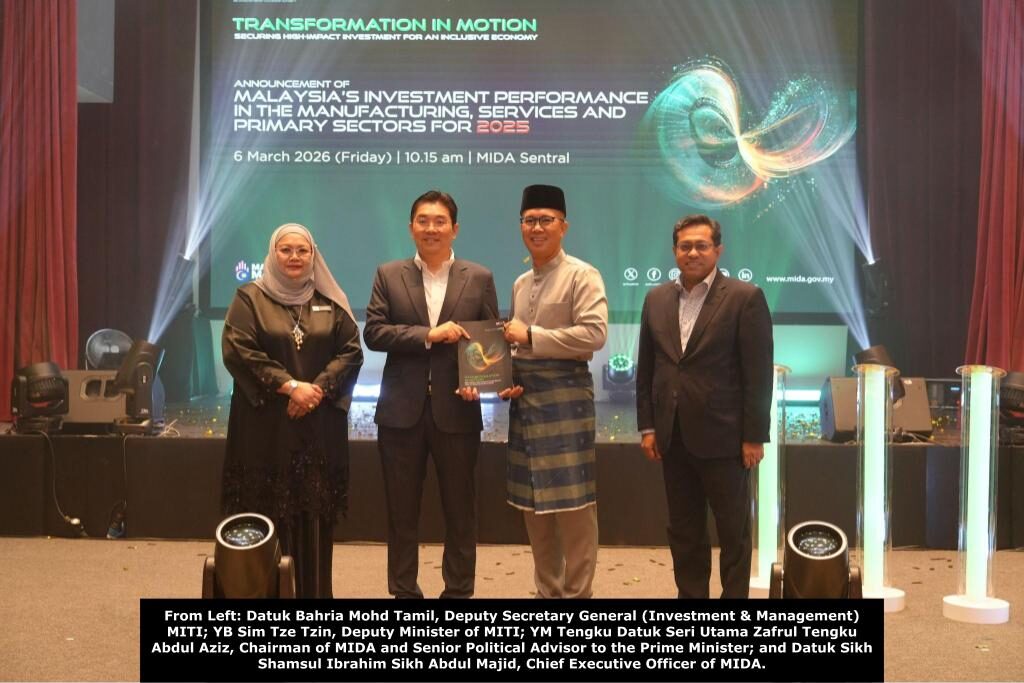
Kuala Lumpur, 6 March 2026 – Malaysia recorded RM426.7 billion in approved investments for 2025, the highest level ever achieved. This represents an 11.0% increase from RM384.4 billion in 2024, marking continued growth in the country’s investment performance. This achievement comes amid a cautious global climate. The International Monetary Fund (IMF), in its World Economic Outlook, projected global growth at 3.3% in 20261.
According to UNCTAD’s Global Investment Trends Monitor (January 2026), although global FDI flows rose 14% in 20252, much of the growth was concentrated in financial centres rather than in productive assets, with actual investment activity remaining subdued. In contrast, Malaysia’s performance is anchored in tangible project commitments: 8,390 approved projects across services, manufacturing, and primary sectors, expected to generate 244,902 new jobs.
Beyond the record total, key indicators also showed improvement. The number of approved projects rose by 9.2%, while expected job creation increased by 17.9%. Domestic investments (DI) totalled RM219.6 billion (51.5%), while foreign investments (FI) increased by 20.9% to RM207.1 billion (48.5%). Foreign investments grew across all three economic sectors: 63.4% in the primary sector, 28.7% in services, and 13.1% in manufacturing – reflecting continued international confidence in Malaysia as an investment destination. This balanced composition reflects strong domestic participation alongside sustained foreign investor interest.
The composition of FI3 also reflects evolving regional trends. Singapore (RM58.3 billion) and the People’s Republic of China (RM58.0 billion) were the two largest sources, followed by the United States (RM15.1 billion), Japan (RM7.6 billion) and Hong Kong SAR (RM7.1 billion), rounding out the top five.
On the domestic front, five states emerged as the leading investment destination: Johor (RM110.0 billion), Selangor (RM83.9 billion), Wilayah Persekutuan Kuala Lumpur (RM63.3 billion), Pulau Pinang (RM32.9 billion) and Kedah (RM27.8 billion), collectively accounting for 74.5% of total approved investments.
1https://www.imf.org/en/publications/weo/issues/2026/01/19/world-economic-outlook-update-january-2026 2 https://unctad.org/publication/global-investment-trends-monitor-no-50
3 Compilation of foreign investments is based on the ultimate source. The ultimate source refers to the home country of the foreign investor that holds control over the decision-making process and investment management, even if the investment flows through several intermediary sources.
“Malaysia’s record RM426.7 billion in approved investments for 2025 is a milestone that belongs to every Malaysian. Through MITI and MIDA’s sustained efforts, we have not only achieved the highest investment approvals in our nation’s history but done so with the right quality. Nearly 245,000 jobs are being created, growth is reaching our Less Developed States, and our manufacturing sector is steadily climbing the value chain. What gives me equal confidence is the balance of this achievement. More than half of our approved investments came from domestic sources, a clear signal that Malaysian businesses believe in this country’s direction and future. At the same time, foreign investment surged by 20.9 per cent, reflecting sustained international confidence in Malaysia as a destination for long-term, high-quality capital. With the New Incentive Framework now in effect and the Thirteenth Malaysia Plan guiding our national ambitions, MITI and MIDA remain fully committed to ensuring that every ringgit invested delivers lasting and meaningful value for the Rakyat.”
— YB Tuan Sim Tze Tzin, Deputy Minister of Investment, Trade and Industry (MITI)
SERVICES SECTOR: SUSTAINING ECONOMIC MOMENTUM
The services sector secured RM281.3 billion in approved investments – 65.9% of the national total – involving 7,004 projects and is projected to generate 134,926 new jobs, the largest share of total job creation.
Domestic sources contributed 63.0% (RM177.2 billion), while foreign investment made up 37.0% (RM104.1 billion), representing a 28.7% year-on-year increase.
Spearheading the Digital Frontier
The information and communication4 sub-sector led the surge with RM152.9 billion. A lion’s share of this approvals is driven by digital investments in Artificial Intelligence (AI), Big Data, data centres and cloud computing.
Data centres are projected to contribute RM14.1 billion to Malaysia’s economy in 2025. And their energy demands are accelerating our transition to renewable energy, driving the expansion of Large-Scale Solar projects toward our goal of 70 per cent renewable energy by 20505.
According to UNCTAD, data centres accounted for more than one-fifth of all global greenfield project value in 2025, with investments exceeding USD270 billion worldwide, driven by demand for artificial intelligence and expanding digital networks6. France, the
4Information and communication comprise of Telecommunications, MSC Status/MD Status and ICT Services 5BNM Quarterly Bulletin Vol. 41 No. 3 Third Quarter 2025
6 https://unctad.org/news/data-centres-are-reshaping-global-investment-landscape
United States, and South Korea were among the leading host countries, while Malaysia was identified alongside Brazil, India, and Thailand as an emerging destination attracting large-scale digital investments.
MITI and MIDA have moved on two fronts:
● The Data Centre Task Force (DCTF), established since February 2025 as a joint platform between MITI and the Ministry of Digital, streamlines the industry’s trajectory to ensure Malaysia remains a competitive and investor friendly regional digital hub.
● Enhancements to the Digital Ecosystem Acceleration (DESAC) scheme, have introduced rigorous sustainability benchmarks, including Power Usage Effectiveness (PUE) and Water Usage Effectiveness (WUE) metrics, while prioritising local ecosystem development through greater participation of local vendors, the creation of high-value jobs, and closer collaboration with universities and technical institutes in IT and engineering to support the digital industry.
Beyond digital investments, the services sector’s growth was further supported by strong performances in:
● Real Estate: RM78.2 billion, 21.2% increase from RM64.5 billion in 2024, involving 1,123 projects across residential, serviced apartment, and commercial developments nationwide, including an integrated energy hub and deep-sea port project aligned with Malaysia’s green energy transition under NIMP 2030 and NETR.
● Utilities7: RM13.7 billion
● Support Services8: RM12.6 billion
● Distributive Trade: RM10.8 billion
MANUFACTURING SECTOR: ADVANCING THE VALUE CHAIN
The manufacturing sector recorded RM131.3 billion in approved investments in 2025, representing 30.8% of Malaysia’s total approved investments, across 1,354 projects. Foreign investments (FI) accounted for RM100.6 billion (76.6%), while domestic investments (DI) contributed a substantial RM30.7 billion (23.4%). This continued inflow of capital underscores Malaysia’s position as a competitive destination for high
technology and advanced manufacturing activities.
7Utilities comprise of Energy (Generation, Transmission and Distribution) and Water (Development of Water Services Industry) 8Support Services comprise of R&D, Logistics Services, Green Technology, Design Services, Professional Services and Other Support Services
A Talent-Driven Industrial Evolution
These investments are projected to generate 109,950 new jobs, with 82.3% (90,497 positions) earmarked for Malaysians. Nearly half of these positions (46.3%) fall within managerial, and technical categories, indicating a continued shift towards higher-skilled employment.
This workforce transformation is reflected in the Managerial, Technical, and Supervisory (MTS) Index, which measures the skill intensity in the manufacturing sector. In 2025, the MTS Index rose to 42.8% (representing 47,111 positions), marking 29.1% year-on-year increase from 41.6% in 2024. This progress supports Malaysia’s goal under NIMP 2030 to build a more competitive and high-income workforce.
To support this momentum, MIDA’s Special Taskforce on Talent Facilitation (STF-TF), comprising 17 ministries and academic institutions works to bridge the gap between evolving industrial needs and talent supply as investments move into higher-value activities.
This focus on higher-value activities is also reflected in key industrial sub-sectors. The E&E industry remains a cornerstone of Malaysia’s manufacturing prowess, securing RM28.5 billion, and affirming its role in the global technology supply chain through AI and green technologies integration. The Chemicals and Chemical Products industry recorded RM24.9 billion in investments, underscoring its importance to Malaysia’s advanced industrial ecosystem.
Other industries contributing to the manufacturing sector’s growth include:
● Transport Equipment – RM14.9 billion
● Basic Metal Products – RM11.1 billion
● Machinery and Equipment (M&E) – RM11.0 billion
INDUSTRIAL CLUSTERS: BUILDING CRITICAL MASS
Malaysia’s key industrial clusters continue to gain depth and momentum, evolving into strong, self-reinforcing ecosystems that attract quality investments. Pulau Pinang’s well-established E&E cluster secured 83 projects worth RM11.3 billion, with 78% driven by foreign investors. This reflects sustained confidence in the state’s five-decade strength in electronics and its critical role in global technology supply chains.
The automotive cluster in Tanjong Malim recorded six projects valued at RM3.6 billion, including new investments in electric and hybrid vehicle manufacturing. This reinforces Malaysia’s growing presence in next-generation mobility and clean transportation technologies.
Meanwhile, the southern petrochemical cluster spanning Pengerang, Tanjung Langsat and Pasir Gudang attracted nine projects worth RM7.5 billion, including Sustainable Aviation Fuel (SAF) production – positioning Malaysia in a niche expected to grow as aviation decarbonisation pressures mount.
PRIMARY SECTOR DEMONSTRATES OPPORTUNITY
The primary sector recorded RM14.2 billion in approved investments, representing 3.3% of the total approvals. Across 32 projects, the sector is projected to generate over 28 new jobs, with investments concentrated in mining (RM14.1 billion) and agriculture (RM51.4 million). While modest in scale, the sector reflects continued strategic interest in resource-based and upstream activities.
INCLUSIVE GROWTH: REACHING BEYOND THE TRADITIONAL CENTRES
The Less Developed States (LDS) – Perlis, Kedah, Terengganu, Kelantan, Sabah, and Sarawak – secured 941 projects worth RM66.0 billion in 2025, representing 15.5% of total national approved investments, and projected to create 23,617 jobs.
Kedah led with RM27.8 billion, driven primarily by manufacturing activities, followed by Sabah (RM14.6 billion) and Sarawak (RM14.2 billion). Although disparities remain, the investment trajectory in these states is consistent with the National Investment Aspirations’ emphasis on inclusiveness and the priorities under the 13th Malaysia Plan (2026-2030).
CONTINUED FOCUS ON QUALITY AND SUSTAINABLE INVESTMENT OUTREACH
Malaysia’s drive to attract quality and sustainable investments continues across global markets. From 2025 to date, MITI and MIDA have undertaken 13 high-level overseas missions to key markets including the United States of America, several European countries, and the People’s Republic of China, complemented by strategic working visits led by the Prime Minister, YAB Dato’ Seri Anwar Ibrahim. These engagements have opened new pathways for investment opportunities worldwide.
This proactive outreach is reflected in Malaysia’s current investment landscape, with a strong pipeline of high-potential projects, reinforcing its position as a competitive investment destination. As of 2 February 2026, MIDA is overseeing 172 pipeline projects with proposed investments totalling RM29.1 billion.
Of these, 101 projects are in the services sector (RM18.4 billion), while 71 projects are in the manufacturing sector (RM10.7 billion).
Additionally, RM65.5 billion in high-potential investment leads are currently under active negotiation by MIDA, reflecting sustained investor confidence in Malaysia’s economic fundamentals.
IMPLEMENTATION OF APPROVED MANUFACTURING PROJECTS Malaysia’s investment performance is measured not only by approvals but by implementation. Strategic platforms such as the National Committee on Investment (NIC), the Investment and Trade Coordination Action Committee, and the Invest Malaysia Facilitation Centre continue to assume a pivotal role in ensuring smooth project execution.
MITI and MIDA continue to work closely with federal and state stakeholders to facilitate and monitor project implementation.
Between 2021 and 2025, the National Committee on Investment approved 4,848 manufacturing projects, of which:
● 84.9% have reached various implementation stages, ranging from production to factory construction and machinery installation.
● 12.0% are in the planning phase, focusing on site selection and consultations with developers.
● Only 3.1% of projects were abandoned, highlighting Malaysia’s strong project realisation rate.
Annual data shows that:
● More than 90% of approved manufacturing projects in 2021 and 2024 have been implemented.
● Projects approved in 2025 have recorded a 62.2% implementation rate, in line with the typical 18 to 24 months development cycle for completion, depending on project complexity.
“Malaysia’s investment success is no accident – it is the product of clear policies, consistent institutions, and the reforms we put in place since early 2023. With the MADANI Economic Framework, NIMP 2030, and MITI’s policy architecture giving investors certainty, and with 84.9% of approved manufacturing projects already realised or underway — we have shown how Malaysia can stay resilient even as the world turns uncertain. The new facilities, advanced technologies, and quality jobs created in recent years reflect our whole-of-nation capability to turn investor confidence into industrial growth, while maintaining Malaysia’s position as a competitive and resilient investment destination.”
— YM Tengku Datuk Seri Utama Zafrul Aziz, Chairman of MIDA and Senior Political Advisor to the Prime Minister.
MODERNISING THE INVESTMENT LANDSCAPE
Malaysia’s record investment performance is being matched by reforms to strengthen its investment architecture. The reforms aim to ensure that Malaysia’s future growth is defined not only by volume, but by quality and long-term economic impact:
● New Incentive Framework (NIF): Effective 1 March 2026, the NIF shifts Malaysia toward an outcome-based model. It prioritises high-impact investments that meet specific National Investment Aspirations (NIA). The framework begins with the manufacturing sector, with a phased rollout to the services sector scheduled for the second quarter of 2026.
● Industrial Development Act 2026: Replacing the Industrial Coordination Act 1975, this represents a generational update of Malaysia’s industrial regulatory framework, introducing a more agile, transparent and facilitative approach to ensure regulation keeps pace with technological advancement and evolving investor expectations.
● Climate Change Bill: Anticipated to be tabled in the current parliamentary session, the Bill will establish the legal architecture for Malaysia’s transition to a low-carbon economy, providing the governance clarity and market signals that sustainability conscious investors increasingly require.
● MIDA Transformation Agenda: MIDA continues to strengthen its role in coordinating the end-to-end investor journey and driving investment policies that support a sustainable and competitive industrial ecosystem.
These initiatives are engineered to reinforce Malaysia’s competitiveness, ensuring that record-breaking investment inflows translate into tangible economic benefits and high quality opportunities for the Rakyat.
A FUTURE BUILT ON RESILIENCE, INNOVATION, AND ECONOMIC PROSPERITY
Malaysia’s transformative investment journey represents a bold step towards building a resilient, innovative, and prosperous future. With a robust policy framework and unwavering investor confidence, the nation is poised to strengthen its global standing as a premier, world-class investment destination.
“At MIDA, our focus goes beyond attracting investments, it is about ensuring that approved projects are implemented efficiently and successfully on the ground. Over the years, we have strengthened our facilitation mechanisms, enhanced coordination across government agencies, and deepened our engagement with investors to support the timely realisation of projects. These efforts reflect MIDA’s ongoing evolution into a more agile and responsive investment promotion agency, committed to partnering with investors throughout their journey and delivering lasting value to Malaysia’s economy.”
— Datuk Sikh Shamsul Ibrahim Sikh Abdul Majid, CEO of MIDA
About The Author