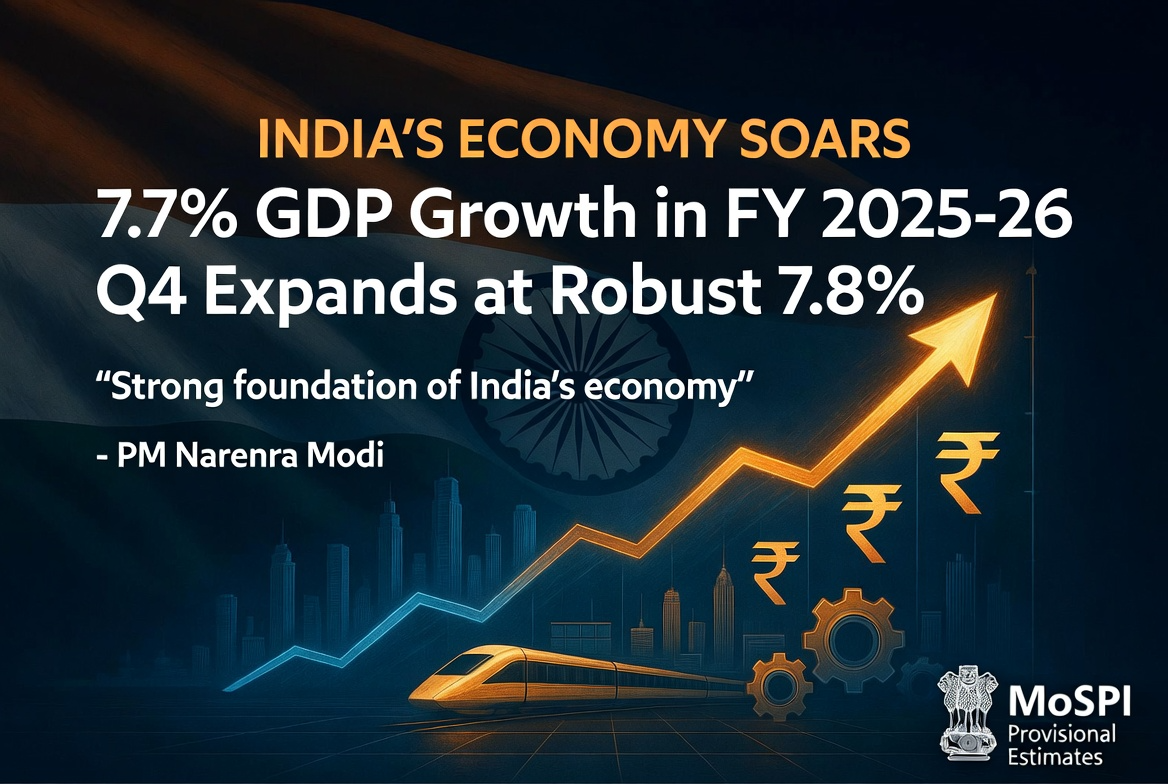
NEW DELHI June 5, 2026 — India’s economy demonstrated strong resilience with provisional estimates showing real GDP growth of 7.7% for the financial year 2025-26, up from 7.1% in the previous year. The fourth quarter (January-March 2026) recorded even stronger expansion at 7.8%, beating market expectations.
According to data released by the Ministry of Statistics and Programme Implementation (MoSPI), real GDP at constant prices reached ₹323.12 lakh crore in FY26, compared to ₹299.89 lakh crore in FY25. Nominal GDP stood at ₹346.36 lakh crore, reflecting an 8.9% increase.
Prime Minister Narendra Modi highlighted the figures in a post on X, stating: “The data that has come out today clearly shows how strong the foundation of India’s economy is. India has achieved a 7.7% growth rate in 2025-26. And in the last quarter… which ended on March 31, India’s growth was also 7.8%.”
Key Drivers of Growth
- Broad-based momentum: Strong performance in manufacturing, construction, trade, hotels, transport, and financial services.
- Domestic demand: Private final consumption expenditure (PFCE) and gross fixed capital formation (GFCF) both showed healthy gains.
- Services sector: Notable double-digit growth in several segments, underscoring the economy’s structural strengths.
The numbers position India as the fastest-growing major economy globally, outpacing peers amid global uncertainties such as geopolitical tensions and moderating growth in China and advanced economies.
While the full-year print exceeded earlier estimates (second advance estimate was 7.6%), the Reserve Bank of India has trimmed its FY27 growth forecast to 6.6%, citing risks from crude oil prices, monsoon variability, and global headwinds.
Economists noted the data reflects sustained investment momentum and domestic consumption, though challenges like employment generation and private sector investment in certain segments remain areas of focus.
This positive close to FY26 reinforces India’s growth story, driven by policy reforms, infrastructure push, and the collective efforts of its citizens, as emphasized by the government. Further detailed sectoral breakdowns are expected in coming releases.
About The Author