PUTRAJAYA April 13, 2026 – Amid the ongoing global energy crunch triggered by the West Asia crisis, Malaysia’s Deputy Minister of Finance Liew Chin Tong has called for the wider and more meaningful embrace of batik as a practical step towards energy conservation, climate resilience and national identity.
In a detailed social media posting titled “Batik for climate”, Liew pointed to the closure of the Strait of Hormuz by Iran following US-Israeli attacks on the Islamic Republic. Despite a two-week ceasefire, the disruption is expected to have lasting effects on global energy supplies.
“There will be many measures to take in addressing the crisis. One important move for us which may carry a deeper meaning of our identity is to embrace batik more actively and in a more meaningful way,” he wrote.
Liew welcomed the recent announcement by Deputy Prime Minister Dato’ Seri Fadillah Yusof encouraging civil servants to wear batik or corporate shirts, allowing government offices to raise air-conditioner temperatures to a more comfortable 24°C or 25°C.
He noted that Western-style suits and ties are ill-suited to Malaysia’s hot and humid climate, a mismatch that historically led to excessively cold indoor temperatures in offices and buildings. Liew questioned the long-held assumption — popularised by former Singapore Prime Minister Lee Kuan Yew — that cooler environments were essential for human and economic development, stating there is no strong scientific evidence to support it.
The Deputy Minister highlighted evolving dress-code trends regionally and globally: Singapore’s Parliament and civil service have become less formal, Indonesia treats batik as equivalent to suit-and-tie attire for almost all occasions, and many Western workplaces have long abandoned daily suits and ties. He cited examples of national attire that rejected the tie as a Western symbol, including India’s Nehru jacket, China’s Mao suit, the Philippines’ Barong, and Iran’s post-revolution ban on ties as a protest against Western imperialism.
Malaysia’s own journey towards more climate-appropriate and culturally rooted attire has accelerated in recent years. On 5 December 2022, Prime Minister Dato’ Seri Anwar Ibrahim and his Cabinet posed for their first official portrait without ties. In February 2023, the Dewan Rakyat Speaker followed suit by making neckties optional for MPs. Effective October 2025, civil servants are no longer required to wear ties during regular working hours or meetings.
Batik promotion has also been institutionalised. Malaysia Batik Day on 3 December was established in 2021, with civil servants initially encouraged — and since August 2023 required — to wear batik every Thursday, while being urged to do so on other days as well. The policy aligns with a 2014 government circular setting office temperatures at 24°C–25°C.
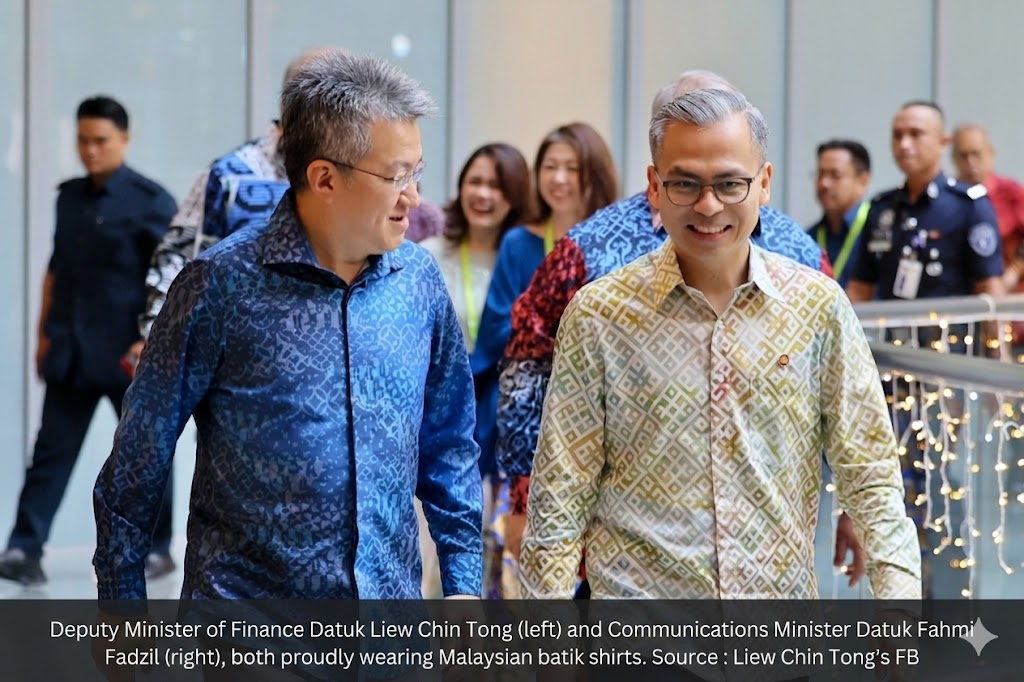
Liew and Communications Minister Datuk Fahmi Fadzil recently visited the Batik Lestari Gallery on the ground floor of the Securities Commission Malaysia, describing it as an excellent initiative that supports local artisans while advancing sustainability and heritage objectives.
“If wearing batik means cooling systems can be set to a higher temperature and thus help with energy conservation, it is good for the climate while also helping with demand management of energy,” Liew said.
He stressed that the energy crisis will not disappear quickly and that Malaysia must adapt for the long term. “The ultimate goal is to build energy resilience for Malaysia. One of the ways is by wearing batik,” he concluded.
The #BatikForClimate campaign continues to gain traction as both a cultural statement and a concrete climate action.
About The Author