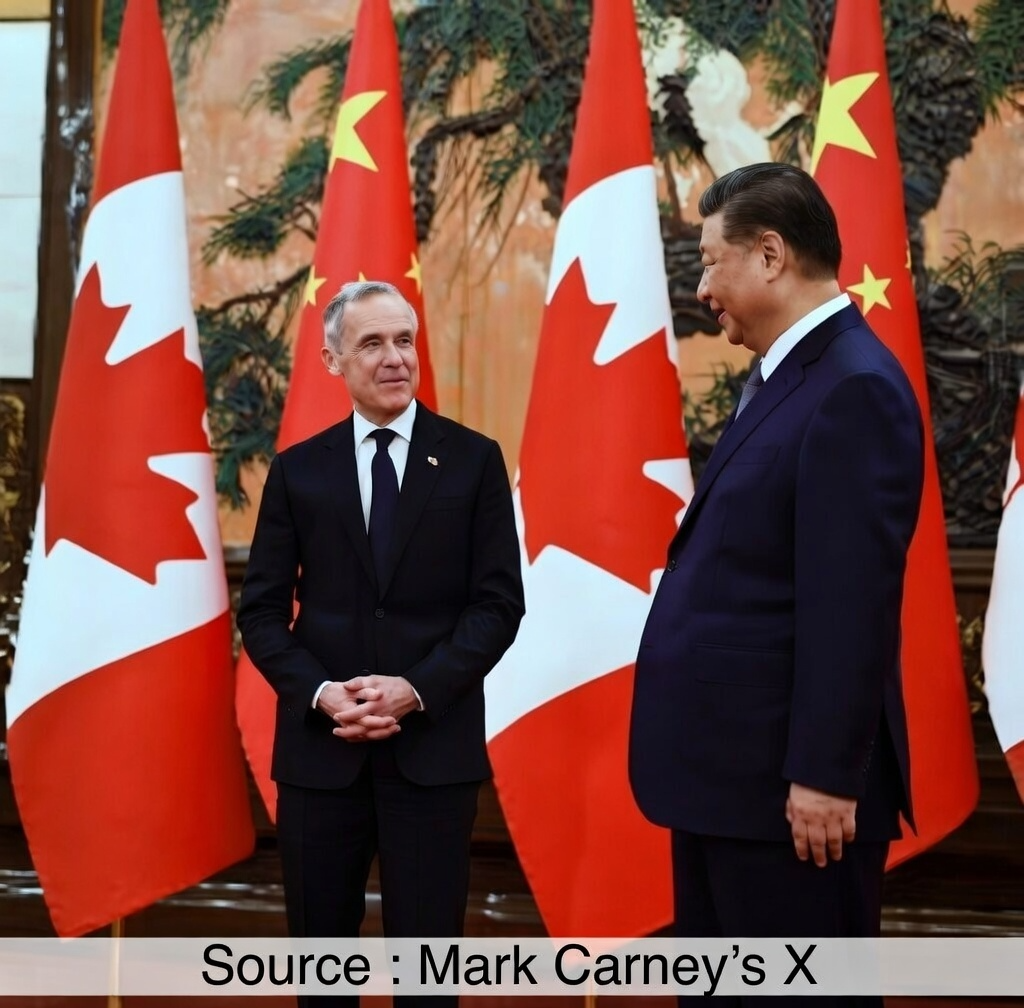
BEIJING/OTTAWA January 19, 2026 – In a move aimed at bolstering Canada’s electric vehicle (EV) sector and enhancing bilateral ties, Prime Minister Mark Carney announced a new strategic partnership with China following high-level talks in Beijing. The agreement, described by Carney as a “preliminary but landmark” deal, will allow a limited number of Chinese-made EVs into the Canadian market while expecting to attract significant joint-venture investments from Chinese firms.
During his visit, Carney met with Chinese President Xi Jinping and business leaders in the energy and clean technology sectors. The pact focuses on collaboration in energy, agri-food, and trade, with a key component being the reduction of tariffs on Chinese EVs. Canada will permit up to 49,000 EVs from China annually at a most-favored-nation tariff rate of 6.1%, down from the previous 100% levy imposed in coordination with the United States in 2024. This quota is set to increase gradually, potentially reaching 70,000 vehicles within five years. Carney emphasized that the move represents a return to pre-trade friction import levels from 2023-2024, amounting to less than 3% of Canada’s new vehicle market.
In exchange, China has agreed to slash tariffs on Canadian canola from 84% to 15% by March 1, providing relief to Canadian farmers. The deal also includes provisions for half of the imported EVs to have an import price under $35,000 by 2030, aiming to offer more affordable, energy-efficient options to Canadian consumers. Carney stated that the agreement is expected to drive “considerable new Chinese joint-venture investment in Canada” within three years, partnering with trusted Canadian entities to strengthen the domestic EV supply chain and create auto manufacturing jobs.
“This is enormous progress,” Carney said, calling it a “new partnership, a new era” that will help Canada double its energy grid over the next 15 years and accelerate clean technology adoption. He added that Chinese car companies have expressed interest in collaborating with Canadian firms to produce EVs domestically, potentially making Canada the first in North America to build such vehicles using Chinese expertise.
The announcement has sparked mixed reactions. Proponents argue it will lower EV prices for consumers, with experts estimating that about 10% of Canada’s EV sales could go to Chinese automakers. esla, which manufactures vehicles in Shanghai, is positioned as an early beneficiary due to its established network in Canada. Chinese EV giant BYD, which already operates a bus assembly plant in Ontario, could also expand under the deal.
However, the pact has drawn sharp criticism from domestic stakeholders. Ontario Premier Doug Ford blasted the agreement as a “terrible deal” that risks undercutting local auto manufacturers and leading to job losses. Ford revealed he and Canadian automakers were informed only hours before the public announcement, lamenting the lack of consultation: “So much for the partnership.” He expressed concerns that allowing subsidized Chinese EVs could “close the door on Canadian automakers to the American market,” especially given that 90% of vehicles produced in Canada are exported to the U.S.
Unions and industry groups echoed these sentiments. The union representing Canadian autoworkers criticized the move, while Ford reiterated that it presents “no jobs coming” for Ontario. Critics, including U.S. officials from the Trump administration, have voiced concerns over potential security risks and trade imbalances. On social media platform X, reactions were largely negative, with users accusing Carney of a “flip-flop” from labeling China as Canada’s “biggest security threat” during his election campaign to now embracing closer ties. One post called it “selling out Canadian auto workers for a handful of cheap Chinese EVs,” while another warned of decimating the industry amid U.S. tariffs.
Carney defended the deal, insisting that any Chinese production in Canada must adhere to the country’s labor standards and that it represents an “opportunity” for Ontario and the auto sector. Canadian officials noted that the U.S. was briefed on the talks, with reactions described as “neutral.” The agreement comes amid broader efforts to reset Canada-China relations, including visa-free travel for Canadians to China and joint initiatives on climate competitiveness.
Analysts suggest the deal signals a strategic pivot for Canada, potentially diverging from U.S. policies on China to secure economic gains in clean energy. However, its long-term impact on jobs, trade relations, and national security remains a point of contention as Parliament prepares to debate the minority government’s bold foreign policy shift.
About The Author