By Nahrizul Adib Kadri
Now that I am the Director of UM Press, I find myself slowly returning to an old habit I had neglected for some time. Reading. Not scanning. Not skimming. But proper reading. Sitting down with a book, turning pages without rushing, letting sentences land. It feels fitting, in a way. Publishing books while forgetting how much I loved reading them would be a strange contradiction.
So I started by re-reading one of my favourites. ‘Blink: The Power of Thinking Without Thinking’ by Malcolm Gladwell, first published in 2005.
I first read it years ago, at a very different stage of life. You know the one: fresh-faced, bright-eyed and bewildered, all at the same time. Back then, I was fascinated by the idea of rapid cognition, how experts could make accurate judgments in seconds. This time, reading it again, something else stood out. Not speed. But trust. Trust in one’s ability to decide, and to live with what follows.
It made me think about how much we hesitate these days.
We hesitate over small things. What to eat for lunch (while having breakfast!). Whether to reply that reminder e-mails now or later. Which route to take home today. And we hesitate over big things too. Career moves. Difficult conversations we know we should have. Decisions we keep postponing because we want to be more certain. But what if some of this hesitation is neither caution nor wisdom? What if it is simply avoidance, dressed up as thoughtfulness?
Gladwell wrote about how we are often capable of making good decisions quickly, as long as we have trained ourselves to notice what matters. That idea stayed with me, especially as I watched my own behaviour. I realised how often I delayed decisions, not because I lacked information, but because I was uncomfortable with responsibility.
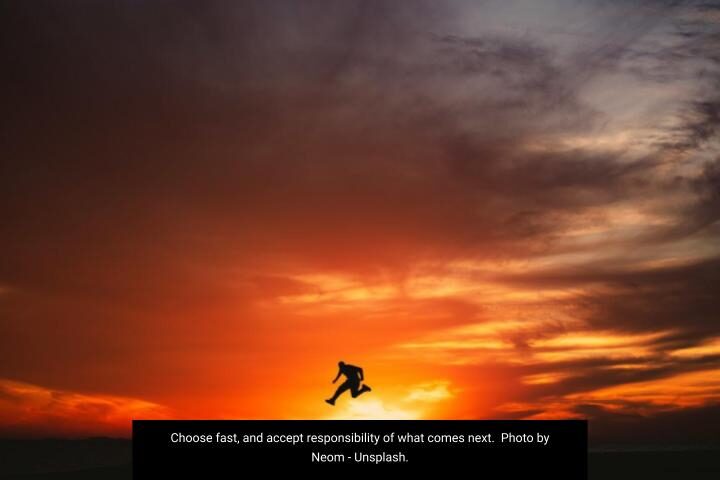
You see, choosing means owning the outcome. And that is the part many of us struggle with. We think the real risk lies in choosing too fast. But sometimes the real risk is never choosing at all.
Over time, I have come to see decision-making as a muscle. One that strengthens with use, and weakens with neglect. If you only wait for perfect clarity, that muscle never gets trained. You remain dependent on external validation, endless comparison, or the illusion that one day the answer will arrive fully formed.
It rarely does.
The training does not begin with life-changing decisions. It begins with small ones. Choosing your meal without scrolling through GrabFood or Google reviews. Sending the email instead of rewriting it ten times. Taking a route home and committing to it. Responding honestly, not just diplomatically.
These choices may seem insignificant. But they do something important. They teach you to stay present. They teach you that most decisions are survivable. They teach you that clarity often comes after movement, not before.
When you decide, you accept that things may not go perfectly. You accept that you may have to adjust. You accept that you will learn something, even if the outcome is not ideal. That acceptance changes how you carry yourself. You stop needing guarantees. You start trusting your ability to respond.
Conviction, interestingly, does not usually precede the decision. It grows after it. The confidence did not come from knowing I was right. It came from knowing I could handle being wrong.
And that is a very different kind of calm. The matured kind.
As I re-read Gladwell’s ‘Blink’, I realised that the book was never really about speed. It was about ‘tuning’. About knowing yourself well enough to recognise when you have just enough information to move. About understanding that wisdom is not always slow, and slowness is not always wise.
Every small decision you make today trains you for a bigger one tomorrow. Every choice strengthens your sense of agency. Every outcome, good or bad, becomes data rather than judgement.
So go ahead and choose your meal. Choose your response. Choose your direction, even if only for now. Learn. Adjust. Move again. Make it yours.
Clarity is not something you wait for.
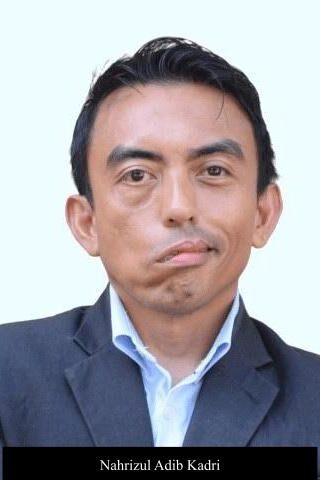
Ir Dr Nahrizul Adib Kadri is a professor of biomedical engineering at the Faculty of Engineering, the Director of UM Press, and the Principal of Tuanku Bahiyah Residential College, Universiti Malaya
About The Author