Of UM’s young researchers and the promise of TMS
Imagine if recovery from a stroke could be aided not only by physiotherapy and medication, but also by a series of gentle magnetic pulses to the brain. This is the promise of Transcranial Magnetic Stimulation (TMS), a non-invasive technique that is beginning to attract global attention in rehabilitation medicine.
Last week, two second-year undergraduate students from Universiti Malaya (UM) had the chance to bring this conversation to an international stage. At the 9th Asia-Oceanian Conference of Physical and Rehabilitation Medicine (AOCPRM) in Penang, Na Risu and Wong Kai Shi presented their research on the use of TMS in stroke recovery.
They were, by far, among the youngest presenters in the convention centre – sharing platforms with experienced medical doctors and rehabilitation specialists from across the Asia-Oceania region.
From lab volunteers to international presenters
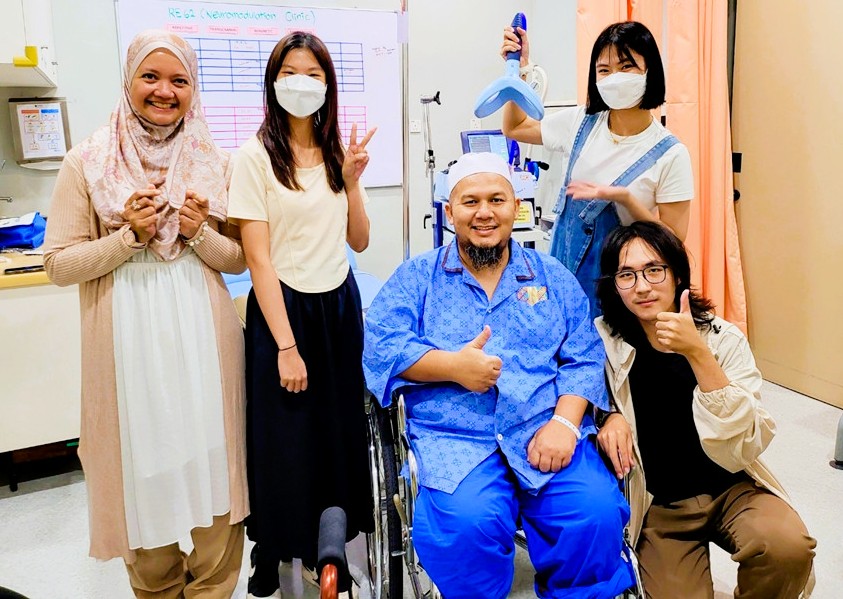
Their journey began in their very first year of study. Instead of taking the semester break as a time to rest, Na Risu and Wong Kai Shi – joined by their classmate, Yong Yi Shean – volunteered in a research project supervised by Associate Professor Ir Dr Nur Azah Hamzaid of UM’s Department of Biomedical Engineering.
The project, funded by the Malaysian Brain, Mind and Neuroscience Research Foundation (YPOMNM), involved close collaboration with rehabilitation experts at Universiti Malaya Medical Centre (UMMC), Professor Mazlina Mazlan and Dr Chung Tze Yang.
Together, the team investigated how muscles in the lower limbs of stroke patients respond to magnetic stimulation, using a technique called mechanomyography to capture subtle signals. The goal: to better assess motor recovery and design more effective rehabilitation strategies.

For Dr Nur Azah, the students’ involvement is about more than data. “This is a very good exposure for them to see how their work is applicable in the real world. I want them to realise the true impact of what they do in the lab,” she explained.
What exactly is TMS?
At its core, Transcranial Magnetic Stimulation is simple in concept yet powerful in effect. An electromagnetic coil is placed against the patient’s scalp, delivering short bursts of magnetic energy thus eddy current to stimulate specific brain regions.
In stroke rehabilitation, this stimulation can encourage the brain to “rewire” itself – a property known as neuroplasticity. By activating areas that control movement, speech, or mood, TMS can complement conventional therapies and accelerate recovery.
Researchers worldwide have documented a range of benefits:
- Safe and non-invasive – no surgery, no anaesthesia, and minimal side effects.
- Motor function recovery – improves strength and coordination in weakened limbs.
- Mood and cognition – alleviates post-stroke depression and cognitive difficulties.
- Complementary care – enhances outcomes when combined with physiotherapy and counselling.
As some scientists like to put it, TMS acts as a gentle “reset button” for the brain – nudging it towards new patterns of activity that support healing.
A fresh perspective for young minds
For the students themselves, stepping onto the AOCPRM stage was nothing short of surreal. “We never imagined that as second-year undergraduates we could already take part in meetings like this. Having the chance to network with real physicians and researchers was eye-opening,” said Na Risu and Wong Kai Shi.
They added: “Although we sort of knew that what we are doing is useful, seeing it being shared and discussed among experts really put things into perspective. It definitely motivates us to take this work further. Thanks to the grant by YPOMNM, we have this opportunity!”
Their reflections highlight a deeper lesson: research is not just about protocols and equipment, but also about confidence and belonging. By presenting alongside seasoned professionals, these young fellows have learned that their voices matter in shaping the future of healthcare.
Why this matters for Malaysia
Stroke remains one of the leading causes of disability in Malaysia, with thousands of patients every year requiring long-term rehabilitation. Traditional therapies – while essential – are often slow and resource-intensive.
The promise of TMS lies in its ability to complement these efforts. If proven effective through more rigorous trials, it could shorten recovery times, reduce healthcare costs, and improve quality of life for patients and families.
That this line of work is being advanced not only by senior clinicians, but also by undergraduates, is significant. It demonstrates the capacity of Malaysia’s education and healthcare institutions to nurture young talent in areas that directly affect public wellbeing.
Inspiration for the next generation
Beyond the scientific findings, the real story may be one of inspiration. In a world where undergraduates are often stereotyped as passive learners, these students chose a different path: to get their hands dirty in a clinical research project, and to carry their findings to an international audience.
Their achievement serves as a reminder that research opportunities can and should begin early. When given the right mentorship and support, even the youngest scholars can contribute meaningfully to society.
As stroke patients in Kuala Lumpur receive gentle pulses of magnetic energy in pursuit of recovery, young researchers like Na Risu, Wong Kai Shi, and Yong Yi Shean are themselves experiencing their own kind of reset – stepping into the world of science not as spectators, but as active participants.
And just like the patients they study, they are learning to move forward, one pulse at a time.
About The Author