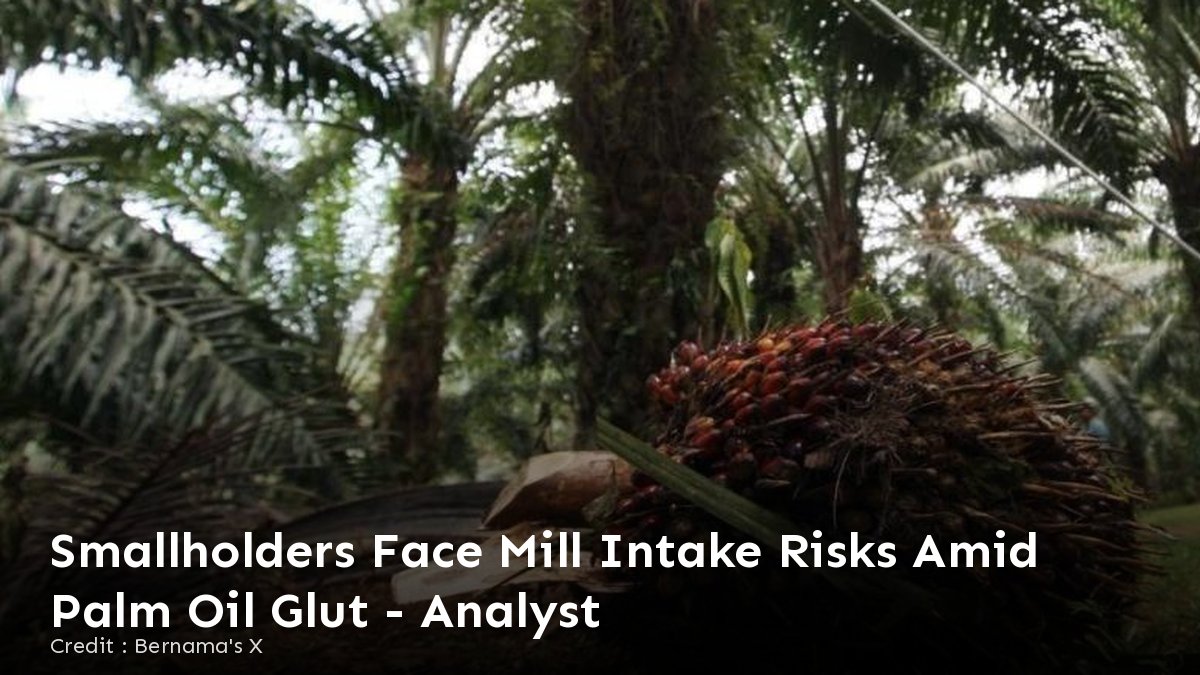
Credit : Bernama's X
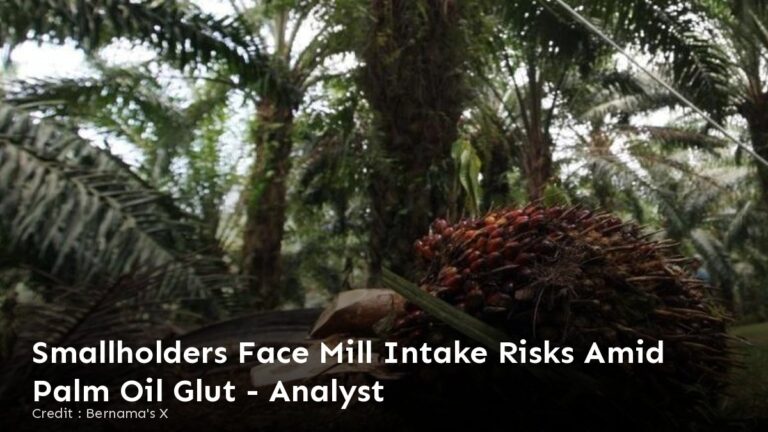
KUALA LUMPUR, Nov 12 – Independent oil palm smallholders are likely to bear the brunt of Malaysia’s rising palm oil stockpiles and softer prices, as they have little room to delay sales and may face tighter mill intake quotas and more rejected fruit, according to an analyst cited by Bernama.
Why smallholders are more exposed
Professor Asad Ata, an expert in operations and supply chain management at the Asia School of Business, told Bernama that, unlike large plantation companies with their own mills and storage, smallholders must sell their fresh fruit bunches (FFB) soon after harvesting to prevent the quality from deteriorating.
He said FFB needs to reach a mill within a day of harvest. Delays push up the free fatty acid (FFA) content, which can lead to lower grading and deductions from payment. “A plantation company with its own mill and storage can hold crude palm oil (CPO) in a tank for a while, at a cost, but a smallholder with three hectares and a lorry coming on Thursday has to sell on Thursday at whatever the dealer offers,” he said.
Asad said a glut rarely begins with a mill simply refusing fruit. It usually starts with the mill setting an intake quota, then rejecting more bunches at grading, and only in a really bad year does a mill shut its gates for a few days.
What the stock figures show
According to the Malaysian Palm Oil Board (MPOB), Malaysia’s total palm oil stocks rose by 110,610 tonnes, or 3.15 per cent, to 3.62 million tonnes in October from September. Palm oil exports surged 55.75 per cent in October to 1.70 million tonnes from a month earlier.
Analysts have expected stocks to start easing in the first quarter of next year as production slows, but Asad said the immediate concern for smallholders is whether nearby mills will keep accepting their deliveries.
Protecting income
He advised smallholders not to cut fertiliser and other essential inputs during the low-price period, warning that this could hurt productivity when the market recovers. “A plantation that goes short of fertiliser this year gives less fruit later, possibly just when prices have recovered,” he said, adding that inputs should be reviewed with someone who knows the plantation rather than cut across the board.
Smallholders should also keep to their harvesting schedules, collect ripe bunches on time and work with reliable dealers who can deliver to several mills, reducing the risk of rejected loads. In his words, one of the most useful protections a smallholder has is the quality of the dealer. He also urged them to keep proper records of FFB weights, grading results and deductions, and to use MPOB’s daily reference prices as a benchmark against dealers’ offers.
Mechanisation and traceability
On longer-term competitiveness, Asad said mechanisation, cooperatives and better access to market information could help smallholders manage costs and strengthen their bargaining power. Sharing machinery through cooperatives, contractors or groups of neighbouring farmers would be more economical than buying costly equipment that sits idle for much of the year. He pointed to harvesters, cutters, small tractors, grabbers and spraying drones as the main tools in the next few years.
He also urged smallholders to keep their land mapping records and certification documents in order to safeguard access to export markets as traceability requirements, particularly under the European Union Deforestation Regulation (EUDR), become stricter. “A plantation with its records in order stands a better chance of having its fruit accepted when mills have to choose between suppliers,” he said.
The report was first published by Bernama on November 12, 2026.
About The Author