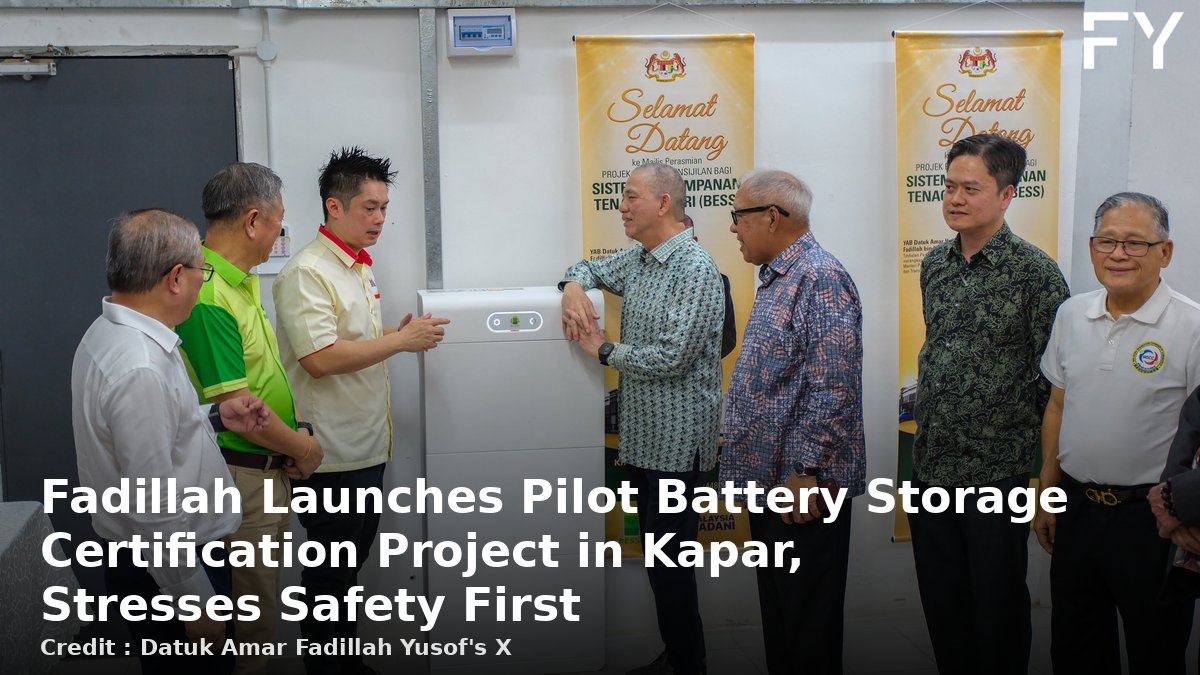
Credit : Datuk Amar Fadillah Yusof's X
KAPAR, November 12, 2026 – Deputy Prime Minister Datuk Amar Fadillah Yusof on Thursday launched a pilot project to certify battery energy storage systems (BESS) in Kapar, Selangor, saying that safety must be the foundation of the technology as Malaysia expands its use of renewable energy.
In a Malay-language post shared on X on Thursday afternoon, Fadillah said he was grateful to have had the opportunity to launch the Pilot Project for Battery Energy Storage System Certification in Kapar. He described the initiative as an important step in Malaysia’s efforts. Photographs released with the post show him touring the venue with officials and guests, and standing beside a battery unit in front of banners welcoming guests to the event.
Reports by The Star, The Vibes and Buletin TV3 said the certification pilot is run by BESSC Sdn Bhd. Fadillah, who is also the Energy Transition and Water Transformation Minister, welcomed the company’s plan to develop an additional certification scheme, saying it would help build a safer, more reliable and more competitive energy storage ecosystem.
He said safety had to come first as battery storage becomes more widely used. According to The Star, he warned that system failures could lead to risks such as thermal runaway and fires, and said every installation must meet high standards of safety, quality and performance, as well as technical requirements and international best practices. “It is not enough to simply possess technology. We must also ensure that the technology entering the country is safe,” he was quoted as saying.
Fadillah explained that BESS allows energy generated from renewable sources such as solar to be stored and used again when needed, which supports grid stability and the management of electricity demand. Buletin TV3 reported that Malaysia’s installed renewable energy capacity is nearing 14 gigawatts, with the government targeting 35 per cent of generation capacity from renewable sources by 2030 and 70 per cent by 2050.
He noted that the Energy Commission (Suruhanjaya Tenaga) has issued Battery Energy Storage System Safety Guidelines setting out technical and safety requirements covering design, component selection, installation, operation and maintenance. The Vibes reported that he said strict controls were needed throughout a system’s lifecycle, including for smaller installations in homes and businesses.
The BESSC certification would be voluntary, Fadillah said, and would serve as added value for the industry rather than replace existing regulatory requirements. Any standards developed must remain aligned with the Energy Commission’s guidelines, he added. He encouraged companies planning to install battery storage systems to seek guidance and use established standards to protect consumers and avoid explosions and fires that could endanger users and the public.
The Deputy Prime Minister also called on relevant agencies, including the Energy Commission and the Department of Standards Malaysia, to facilitate BESSC’s certification application process. Buletin TV3 added that the Energy Transition and Water Transformation Ministry would continue to support the initiative through strategic cooperation, technical guidance and coordination among stakeholders.
Separately, Buletin TV3 reported that Malaysia is widening the use of battery storage through the MyBEST tender, which involves 400 megawatts of power capacity and 1,600 megawatt-hours of storage capacity. The pilot certification project is aimed at ensuring that systems installed as that capacity grows meet recognised safety benchmarks.
About The Author