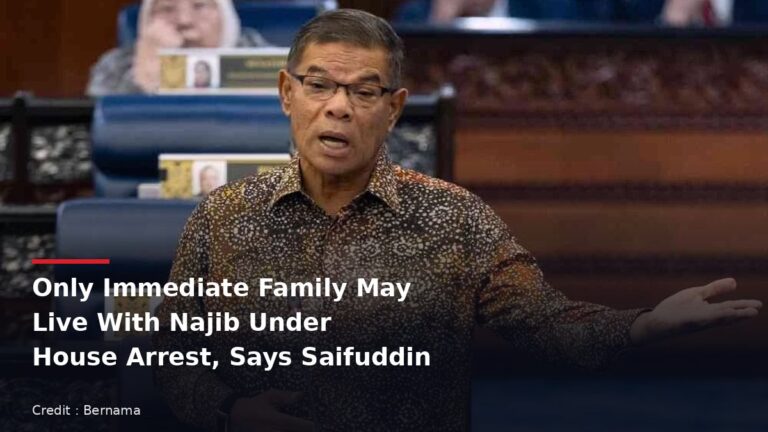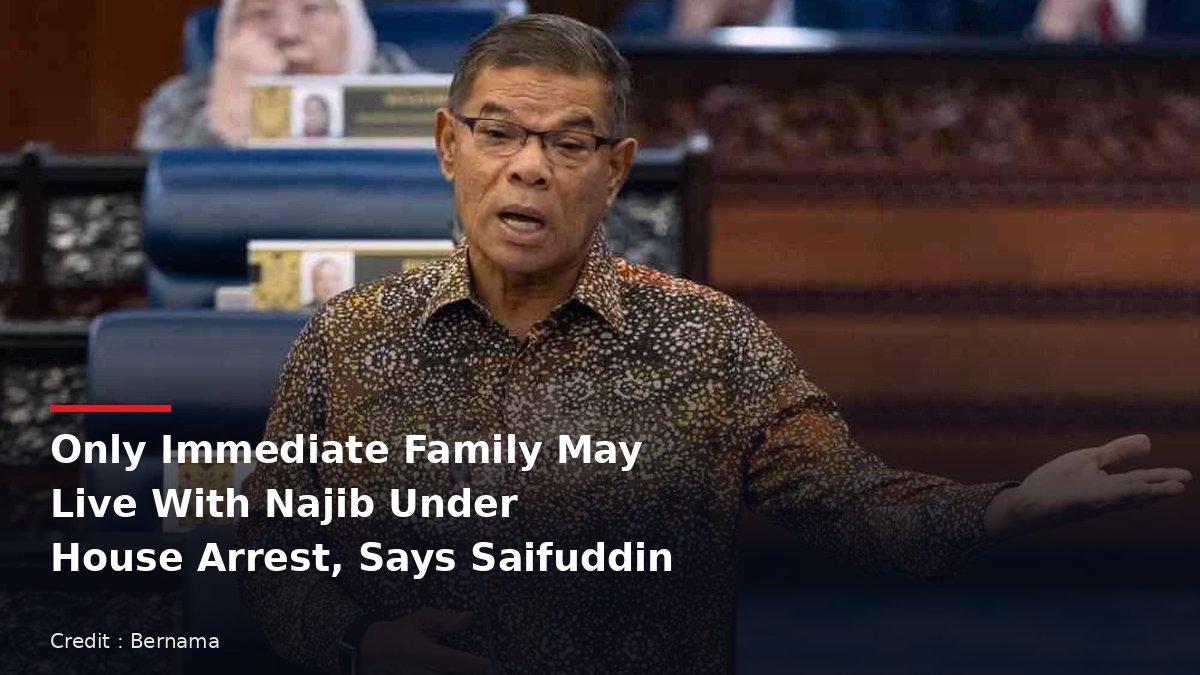
Home Minister Datuk Seri Saifuddin Nasution Ismail speaking during oral question time in the Dewan Rakyat in Kuala Lumpur on November 12, 2026. Credit : Bernama
KUALA LUMPUR, November 12, 2026 — Home Minister Datuk Seri Saifuddin Nasution Ismail on Thursday outlined in the Dewan Rakyat the conditions of former prime minister Datuk Seri Najib Razak’s house arrest, saying a conditional pardon order from the Pardons Board had been sent to the Ministry of Home Affairs (KDN), specifically the Prisons Department, for implementation.
Responding to Suhaizan Kaiat (Pulai), Saifuddin said the order has two parts. The first states that Najib is placed under house arrest, subject to payment of a RM50 million fine, and is to be released on 23 August 2028 — unlike an earlier Pardons Board decision, which provided for release rather than house arrest. The second sets out the conditions attached to the order.
Najib was convicted under the Malaysian Anti-Corruption Commission Act, the Penal Code and the Anti-Money Laundering, Anti-Terrorism Financing and Proceeds of Unlawful Activities Act (AMLA). His case proceeded through the High Court, the Court of Appeal and the Federal Court, and he was sentenced to 12 years’ imprisonment and a RM210 million fine.
Saifuddin said Najib submitted a petition for a pardon on 21 January 2024. The Pardons Board, then chaired by the previous Yang di-Pertuan Agong, decided that he was to be released on 23 August 2028 and to pay a fine of RM50 million, reduced from RM210 million. Failure to pay the fine would add one year to the prison term. On 18 September, Najib received a further conditional pardon order from the Pardons Board chaired by the present Yang di-Pertuan Agong, which was then sent to KDN, specifically the Prisons Department, to be carried out.
The conditions set by the Pardons Board fall into four main categories: restrictions on residence and association; controls on movement and visits; restrictions on the use of telephones and telecommunications devices; and mandatory attendance at rehabilitation and intervention programmes. The Prisons Department may also impose additional conditions for control, supervision, instructions and procedures. Saifuddin said all of this was read to Najib two days earlier, before he was released from prison and taken to his residence in Jalan Langgak Duta.
The board’s decision names the residence as No. 11, Jalan Langgak Duta. KDN used its powers under Section 3 of the Prisons Act to gazette the premises as a place of detention. Najib is not allowed to move to another house, building or premises, and may not leave that address except with written permission.
He may live only with family members comprising his wife, children, children-in-law and grandchildren. Anyone staying with him, including those family members, requires prior written approval from the Prisons Department (the Director-General of Prisons).
On telecommunications, Saifuddin said Najib may not use any equipment other than devices registered by the Prisons Department to verify his presence at the residence. He is not allowed to involve himself in, make any statement or comment, or appear in any media coverage or on social media platforms, and is prohibited from attending gatherings, let alone taking part in political activities. There is also an obligation to undergo a rehabilitation programme. Saifuddin emphasised that the conditions were not drawn up only for Najib’s case, but also as preparation for any similar case in the future.
Answering Pulai specifically, he said the conditions came with the annex to the Pardons Board’s decision, the Commissioner-General of Prisons had drawn up conditions for control and supervision under the Prisons Act, and Najib had submitted a written request for additional conditions, including consideration of a second house. “At present, we are bound by the Pardons Board’s decision that the place of detention is only one residential address. Therefore, that request cannot be fulfilled,” Saifuddin said.
In a supplementary, Pulai asked about the impression of “two-tier” justice and any additional cost. Saifuddin said Malaysia is a country governed by the rule of law, with three main phases. First, a person who has been charged, convicted and has gone through the courts has a legal right to petition for a pardon, a right open to all, whether rich or poor. Second, the Pardons Board acts under Article 42 of the Federal Constitution, chaired by the Yang di-Pertuan Agong, and KDN has no authority over whether a petition is approved. Third, once a decision is issued, KDN, through the Prisons Department, must carry it out in accordance with the law. Public perception could not be avoided, he said, but the government held to equality before the law and had to ensure that implementation rested on firm procedures and a legal basis.
On cost, he said Najib holds two capacities: as a former prime minister, and, in prison terms, as a prisoner serving his sentence. Facilities for a former prime minister are subject to the Federal Constitution and Cabinet circulars, and he understood that only pension payments have been stopped for now, a matter under the Prime Minister’s Department (JPM) or the Legal Affairs Division (BHEUU). At the residence, the Prisons Department has placed three prison officers on each shift, while the Royal Malaysia Police (PDRM) also maintains a static and continuous presence. This was only a redeployment of existing duties from Kajang Prison to the residence, he said, and no specific additional cost was involved.
Responding to Datuk Seri Takiyuddin Hassan (Kota Bharu) on coordination over the release, Saifuddin said that on the morning of Friday, 6 November, Najib paid the RM50 million fine and the court issued an order of discharge forthwith. From the Prisons Department’s standpoint, once a document stated “release”, the prison authorities no longer had authority over the detainee — whether to keep him in custody, implement house arrest, or grant a licensed release or parole.
Because of the confusion in the court document, KDN referred the matter to the Attorney-General, the government’s legal adviser. “We in KDN are the implementers, not the administrators of the law,” Saifuddin said. After the matter was brought back to court, a High Court judge cancelled the original discharge order issued on 6 November, and the court issued a new conditional release order consistent with house arrest.
He said the Attorney-General’s action was necessary because of ambiguity in the release directive given to the implementing agency. KDN did not question the Pardons Board’s decision or take away the detainee’s rights, and rejected any suggestion that it had deliberately defied the order or caused delay. Loyalty to the royal institution did not mean the legal process could be disregarded, he said, and upholding the rule of law did not mean questioning the royal institution. Both must proceed together in a country that practises parliamentary democracy and constitutional monarchy.
Responding to Ramkarpal Singh (Bukit Gelugor) on whether a breach could lead to the house arrest being revoked, Saifuddin said the procedural conditions state clearly: “If any breach occurs, the party who breaches the condition will be immediately returned to Kajang Prison or any prison determined by the Commissioner-General.” The details, he said, were set out in the prisons compliance instructions and procedures. “The principle is clear: conditions are given, and if they are breached, the order will be revoked immediately and the detainee returned to prison.”
Syed Saddiq Syed Abdul Rahman (Muar) asked whether the minister would propose that the Cabinet declassify the Pardons Board’s report so the matter could be explained fully to the public. Saifuddin called it a good suggestion from Muar, namely to take to the Cabinet a proposal to declassify the minutes of the Pardons Board meeting for a more accurate and transparent view of the process. Although the matter falls under the Attorney-General’s purview, he said he had no objection. “Tomorrow, in the Cabinet meeting, I will take the liberty of bringing this as a specific suggestion from a member of the House for consideration,” he said.
About The Author