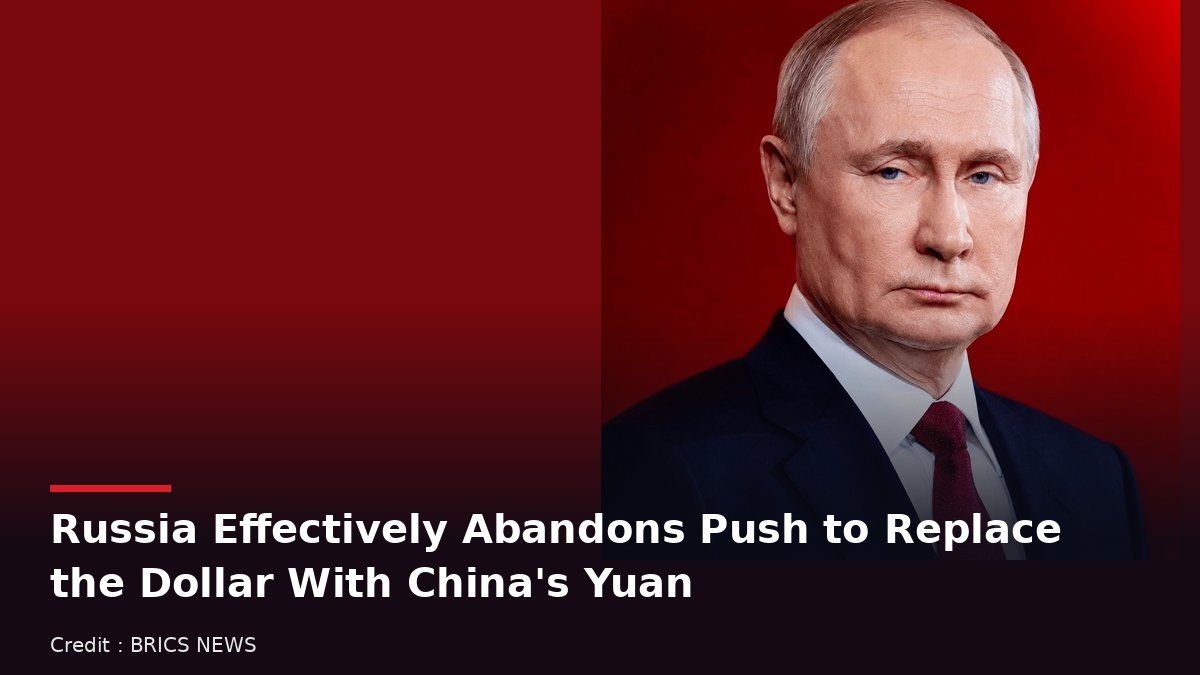
Credit : BRICS NEWS
MOSCOW, November 11, 2026 – Russia has effectively abandoned its effort to replace the US dollar with China’s yuan in foreign trade under pressure from US secondary sanctions, Bloomberg reported on Wednesday, in a development first flagged on BRICS News.
The yuan’s share of payments for Russian exports has fallen by half this year to 22 per cent from its mid-2024 peak, when Washington widened secondary sanctions, according to the latest data from the Bank of Russia cited by Bloomberg and reported by Meduza and The Edge Malaysia. In trade with Asia, Russia now receives roubles for 69 per cent of its exports, the same reports said.
Russia turned rapidly to the yuan after the start of its full-scale war against Ukraine in 2022 and the imposition of Western sanctions. By 2024 the Chinese currency accounted for nearly half of Russia’s foreign trade settlements, had become the most traded currency on the Moscow Exchange and had overtaken the dollar in bank deposits, Bloomberg reported, as cited by Meduza.
The reversal began after the United States significantly widened the grounds for secondary sanctions on financial institutions dealing with Russia in June 2024. Fearing those restrictions, Chinese banks started cutting ties, freezing payments and returning transfers, Meduza said, citing Bloomberg. China’s largest lenders stopped dealing completely with Russian counterparties, according to the same reporting. Russia’s economy, by then heavily reliant on the yuan, faced a shortage of foreign currency, and the Bank of Russia eventually urged lenders to restrain yuan-denominated credit, The Edge Malaysia reported, citing Bloomberg.
The shift has made cross-border payments slower, costlier and less predictable. Companies unable to settle directly in yuan have turned to intermediaries and third countries. Alexander Vedyakhin, first deputy chairman of Sberbank, Russia’s largest lender, said that even after Russia and China formally moved towards trade in national currencies, payments were prone to constant disruptions, The Edge Malaysia reported, citing Bloomberg. Alexander Gabuev, director of the Carnegie Russia Eurasia Center, said: “Normal banking payments have shrunk dramatically.”
Some channels remain open, but none guarantees that a transaction will succeed, sources at firms that help Russian businesses pay counterparts in China told Bloomberg. Many payments now go through agents rather than banks, a route described as more reliable but more expensive. The total cost of cross-border payments with China now averages 15 to 20 per cent of the transaction, including commissions and fees, according to data from logistics firm STT Logistics cited in the Bloomberg report.
The experience underlines the limits of efforts to find an alternative to the dollar. Chinese officials have said they are not trying to turn the yuan into a replacement for the dollar, and Beijing maintains tight capital controls, Bloomberg reported. The yuan’s share of global payments has returned to its pre-war level, according to the same reporting cited by Meduza.
BRICS News said Russia had “effectively abandoned efforts to replace the US dollar with China’s yuan following pressure from US secondary sanctions.” The underlying figures come from the Bank of Russia and were first detailed in the Bloomberg report.
Source: BRICS NEWS; Bloomberg via Meduza and The Edge Malaysia
About The Author