Credit : Datuk Seri Anwar Ibrahim's X
KUALA LUMPUR, November 10, 2026 – Prime Minister Datuk Seri Anwar Ibrahim has shared a well-known hadith on equal justice, quoting a saying of the Prophet Muhammad that earlier nations were destroyed when they let the powerful go unpunished for theft but enforced the law on the weak.
In a post shared on X on Tuesday evening, Anwar wrote in Malay that the narration was from Aisha, may Allah be pleased with her. He did not add any comment of his own, and he did not name any person, institution or court case.
The text he posted
A faithful English rendering of his wording is: “Indeed, what destroyed the nations before you is that when a person of high standing among them stole, they let him be. But when a weak person among them stole, they carried out the hudud punishment on him.”
The post continued: “By Allah! If Fatimah, the daughter of Muhammad, were to steal, I would surely cut off her hand.” Anwar attributed the narration to Sahih al-Bukhari, citing entry 3475.
Hudud refers to a set of fixed punishments under Islamic criminal law. Fatimah was the Prophet’s daughter. By invoking her name, the saying underlines the principle that no one, however close to power, stands above the law.
The fuller narration in Bukhari
The citation given by the Prime Minister is a standard numbering for a hadith collected in Sahih al-Bukhari. The fuller entry also records the background to the sermon. According to that narration, the Quraysh were concerned about a woman from the Banu Makhzum who had committed theft, and they looked for someone to intercede with the Prophet on her behalf. They turned to Usama ibn Zayd. The Prophet asked whether he was trying to intercede in a matter involving one of the prescribed punishments, then rose and delivered the warning that Anwar quoted.
Anwar’s post reproduced the warning itself, not that surrounding account. Life News Agency has not treated the wider background as words he wrote on Tuesday, only as the context of the text he cited.
Posted on a day of legal and political debate
The X post is timestamped 12:32 UTC on November 10, or 8.32pm Malaysia time. Earlier the same day, as reported by Life News Agency from a Home Ministry statement, the ministry said the government was ready to implement a High Court order connected with the royal pardon and house-arrest arrangements involving former prime minister Datuk Seri Najib Razak. Transport Minister Anthony Loke also announced his resignation with immediate effect after that court ruling, in a statement issued in his own name.
Those events had already generated sharp public argument about the law, the Attorney General’s Chambers and whether institutions were being respected. Anwar’s post did not mention Najib, Loke, the court or the pardon. Readers may draw their own conclusions about the timing; the Prime Minister himself offered no explanation.
A familiar theme, stated through scripture
The hadith is frequently cited in discussions of justice because it rejects the idea that rank or family ties should shield an offender. In the version Anwar posted, the contrast is between “orang yang berkedudukan tinggi” — people of high standing — and “orang yang lemah”, the weak. The standard English translations of Bukhari 3475 use similar pairings, such as the noble and the poor, or the noble and the weak.
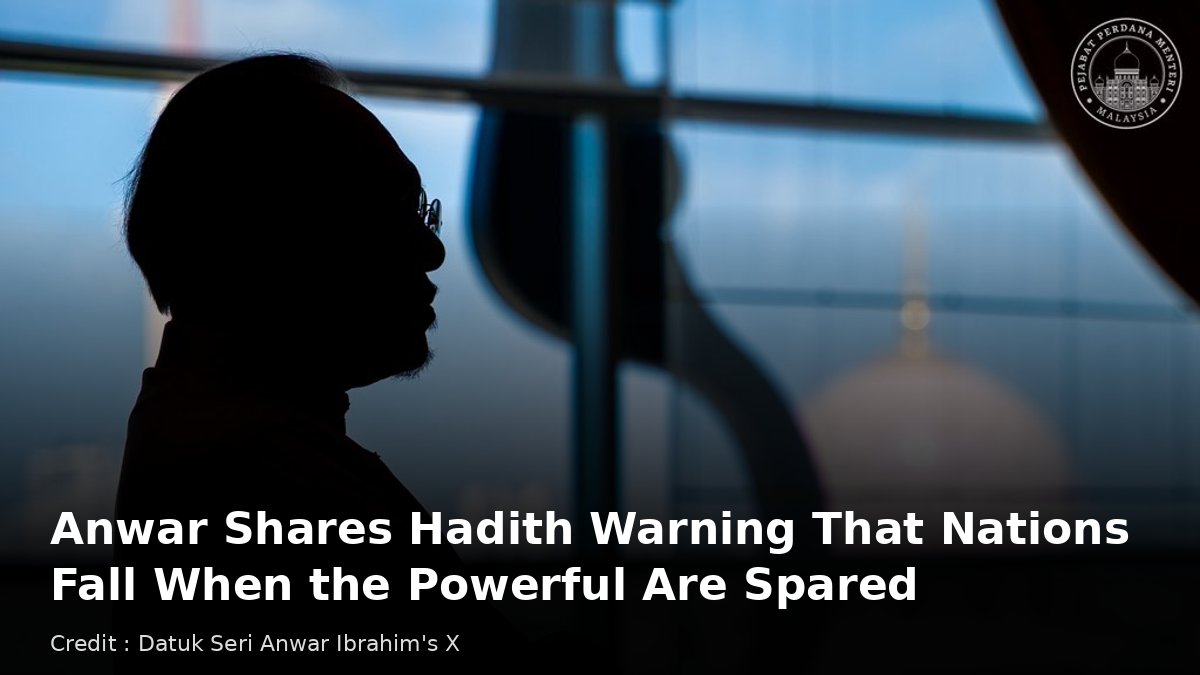
By posting the text without commentary, Anwar left the message to stand on its own. He attached a photograph of himself in silhouette against a window, with a mosque dome visible beyond the glass and the official seal of the Prime Minister’s Office in the corner.
The post quickly circulated on X. Life News Agency is reporting what Anwar wrote and the citation he gave, and has checked the Bukhari numbering against published editions of the collection. It has not independently interpreted the hadith as a statement on any particular case, because the Prime Minister did not make that link in the post.
Source: https://x.com/anwaribrahim/status/2120132427922432460
Credit : Datuk Seri Anwar Ibrahim’s X
About The Author