Credit : Reuters' X
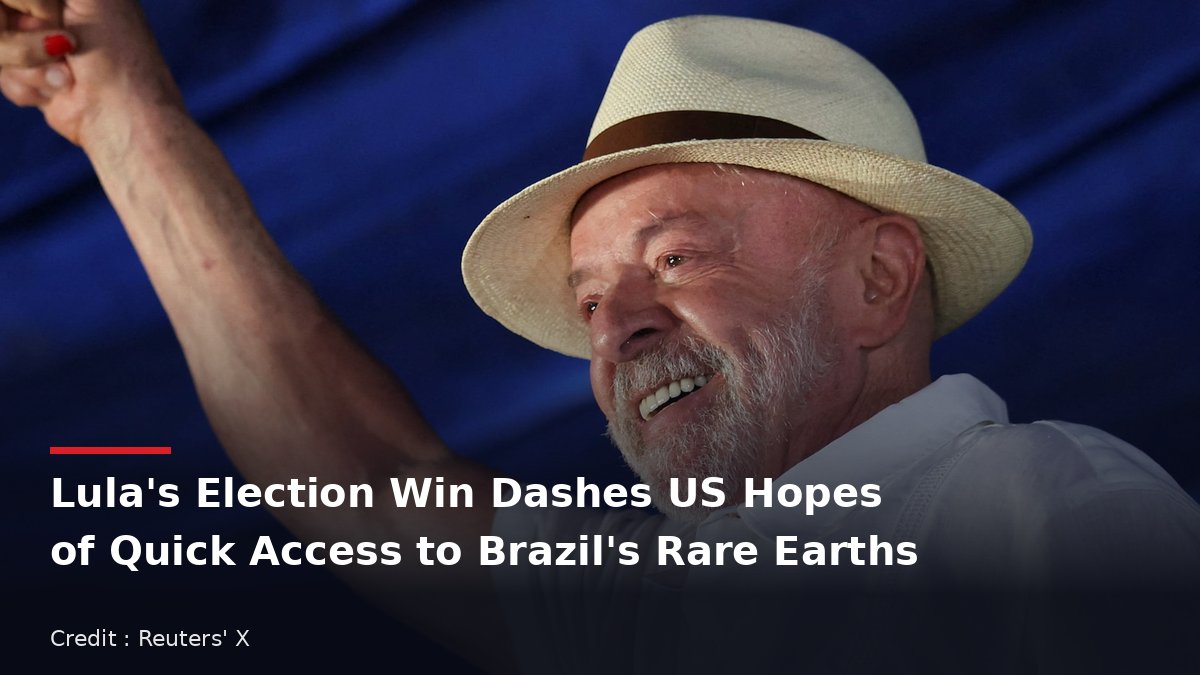
RIO DE JANEIRO, November 5, 2026 — The re-election of leftist Luiz Inacio Lula da Silva as Brazil’s president will likely dash US President Donald Trump’s hopes of securing fast access to the world’s second-largest rare earth reserves, Reuters reported.
Reuters reported on X that Lula’s win undercuts Washington’s push for quick preferential access to Brazilian rare earths. A victory last month for Lula’s challenger, Flavio Bolsonaro — whose family is close to Trump — could have sped up US investment in Brazil’s mineral wealth as Washington races China for materials used in technology, cars and energy systems, according to the Reuters analysis carried by Investing.com and The Straits Times.
Instead, Lula’s government plans new regulations for the sector through the National Council for the Industrialisation of Critical and Strategic Minerals (CIMCE). Three council members told Reuters ahead of the body’s first meeting on Thursday, which Lula attended, that US investment would still be welcome but that processing rare earths inside Brazil would take priority over exporting them as raw materials.
Local processing over raw exports
“What’s most important is to produce more in Brazil. To process, manufacture, add value and invest in knowledge, research and development,” said Marco Lage, a CIMCE member who represents mining municipalities. “That’s what China has been doing for 30 years.” Eracy Lafuente, a CIMCE member and chief of staff to the governor of Bahia state, said Brazil wants foreign investors to refine locally and share technology, while insisting the United States “will not be sidelined.”
Trump had sought preferential access to Brazil’s rare earths, a US State Department official with knowledge of the talks told Reuters earlier this year. After meeting Trump in May, Flavio Bolsonaro promised a “long-term strategic partnership” over the deposits. White House spokesperson Matthew Middleton told Reuters that diversifying the US minerals supply chain was in the interest of both countries and that the administration remained committed to partnerships that deliver “tangible results” for Americans.
Analysts had expected Flavio Bolsonaro would scrap CIMCE if elected, easing pressure on firms to build a downstream rare earths industry. Lula signed Brazil’s National Policy for Critical and Strategic Minerals into law about two weeks before the first round of voting, creating CIMCE, investment incentives and risk-mitigation tools for investors.
Limits on a quick build-out
At its first meeting the council classed 27 minerals under its purview, listing rare earths as a “high priority”. CIMCE can review corporate-control changes at firms holding critical-mineral rights and approve international supply contracts for “economic or geopolitical security”. Lafuente said regulations would be presented “within the first few months of 2027”.
Ramon Barua, chief executive of Aclara Resources, which is developing a rare earths mine in Goias state, said Brazil still lacks separation technology: “Even if we wanted — or even if President Lula wanted — to have separation in Brazil today, I don’t think that’s possible. We need to acquire the technology first.” Only the US government-backed Serra Verde mine, bought by USA Rare Earth in September, is commercially operating in Brazil, and the company does not expect full capacity until the end of next year, Reuters reported.
China holds the world’s largest rare earth reserves, making Brazilian deposits strategically important for supply-chain diversification. Mining.com noted Brazil’s mapped rare earth reserves at about 21 million tonnes, second only to China, while foreign firms have filed a large share of recent exploration applications. LNA will continue to follow the CIMCE rule-making and any US-Brazil minerals talks.
Credit : Reuters’ X, with reporting from Investing.com, The Straits Times and Mining.com.
About The Author