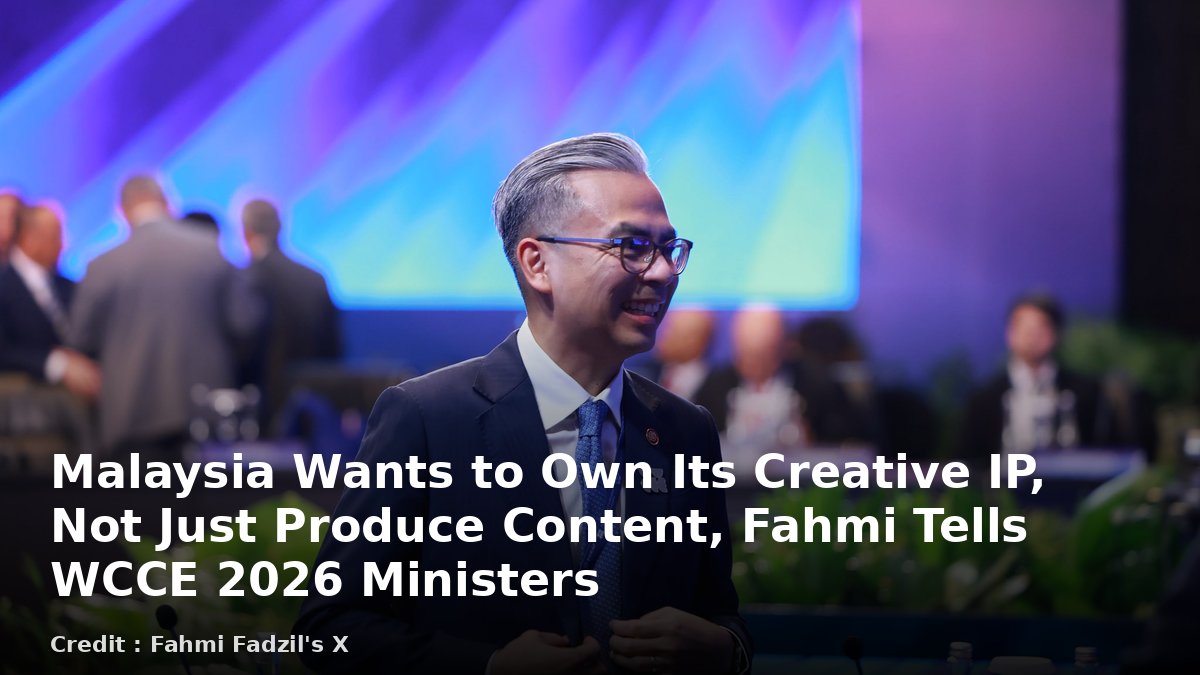
Credit : Fahmi Fadzil's X
JAKARTA, October 22, 2026 – Malaysia wants its creative talent to own and commercialise the intellectual property (IP) behind their work rather than simply produce content for others, Communications Minister Datuk Seri Fahmi Fadzil told fellow ministers at the Fifth World Conference on Creative Economy (WCCE 2026) in Jakarta on Thursday.
Sharing Malaysia’s views on the direction of the creative economy at the conference’s Ministerial Meeting, Fahmi said in a post on his X account that the country’s cultural and creative industries contributed 6.8 per cent of gross domestic product (GDP) in 2024, generated RM63 billion in exports and supported more than 760,000 jobs.
“The creative economy is among the country’s new sources of growth, not merely a side sector,” he wrote.
“We want to move from simply producing content to owning and commercialising our own intellectual property, while strengthening talent, financing and the responsible use of AI,” Fahmi added.
He said Malaysia had also proposed closer cooperation in international co-productions, the exchange of creative talent and the sharing of industry data.
Fahmi said Malaysia was pleased to join the consensus adopting the Jakarta Vision on Creative Economy as the outcome document of WCCE 2026, describing it as “another step to strengthen international cooperation and open up more opportunities for the creative community.”
“We want creative talent not just to produce works, but to own their value, build careers from them and carry our stories further into the world,” he said.
Three proposals for the global creative economy
In his intervention at the meeting, reported by The Star and The Edge Malaysia, Fahmi set out three recommendations: that intellectual property be recognised as a bankable asset, that creative skills be developed alongside digital skills, and that clear frameworks govern the responsible use of AI in creative work, “keeping the human creator at the centre.”
On the three areas for closer international cooperation, he said co-productions could help grow the creative economy by attracting investment, developing local talent and bringing content to wider international markets, while talent mobility through joint training, residencies and exchanges would let professionals learn from one another and build lasting collaborations.
The third, he said, was sharing data and measurement methods “so that the creative economy is properly counted in our national accounts,” adding that a clearer picture of its contribution to jobs, income and growth would help governments design better policies and make a stronger case for investment.
Fahmi also pointed to challenges common to creative industries, noting that creators often provide production services while ownership of the IP and its commercial value remain elsewhere. “Creative enterprises, whose main assets are intangible, still struggle to access financing, and generative AI raises pressing questions on copyright, fair remuneration and cultural authenticity,” he said.
Jakarta Vision heads to the UN
According to Indonesia’s ANTARA news agency, the ministerial meeting was attended by 38 heads of delegation, including ministerial-level delegates from Australia, Malaysia, Singapore, Ukraine and Russia. Indonesian Creative Economy Minister Teuku Riefky Harsya said Indonesia, through its Foreign Ministry, would table the Jakarta Vision as a resolution at the United Nations General Assembly in New York in December 2026.
The document focuses on four pillars: technology, AI and digital transformation under human-centred AI governance; sustainable development and the circular economy; intellectual property, creative rights and a fair economy for creators; and inclusivity and community empowerment, including better access to funding and investment for creative businesses.
Riefky told a press conference on October 23 that WCCE 2026, held from October 21 to 23, drew participants from more than 80 countries, over 6,100 attendees and around 180 speakers, Tirto reported.
Fahmi’s Jakarta visit also included meetings with Netflix and with Indonesian ministers on deeper Malaysia–Indonesia cooperation in film, animation, music and concerts.
About The Author