By Nahrizul Adib Kadri
I wanted to buy something simple.
It was one of those evenings when you open a shopping app (yes, the orange one) intending to spend five minutes buying a single item, only to realise an hour has quietly disappeared. There were hundreds of choices. Different brands, different colours, different prices. One seller had better ratings. Another offered a lower price. A third promised next-day delivery.
Like many people, I began reading the reviews. The five-star ones first, followed by the one-star reviews, just to see what might go wrong. Then came the comparison videos on TikTok, followed by photographs uploaded by previous buyers, and before I knew it, I was comparing products I had never intended to buy in the first place.
Eventually, I found one that seemed just right, priced at RM21.50. I added it to my cart and proceeded to the checkout page, only to be greeted by a familiar message: “Add RM3.50 more to enjoy FREE SHIPPING.”
It is amazing how persuasive those few words can be.
Suddenly I was browsing charging cables, phone stands and USB adaptors, trying to convince myself that perhaps I should add one more item to the order. Never mind that I already had a perfectly good adaptor at home. A spare one for the office, I reasoned, would surely come in handy one day. Five minutes earlier, I had absolutely no intention of buying it. Yet somehow, my mind had become surprisingly good at manufacturing sensible reasons for spending a little more.
I eventually completed the purchase. The order was confirmed, the payment went through, and almost immediately I closed the app. It never occurred to me to continue comparing prices or searching for better options elsewhere. Not because another seller might not have offered a better deal the following day, but because there was no longer any value in continuing the search. The decision had been made. The only thing left to do was wait for the parcel to arrive.
Then it struck me that we rarely treat the bigger decisions in life with the same kindness.
Choosing a university course, for instance, often begins with excitement before doubt quietly joins the conversation. A student may have loved chemistry since secondary school, represented the school in science competitions, and genuinely enjoyed spending hours in the laboratory. Choosing a degree in chemistry feels like the most natural decision in the world until someone asks, “But what kind of job will you get afterwards?”
The same thing happens elsewhere in life. Two people may have been together for four years. Their families know each other, their friends already assume marriage is only a matter of time, and yet another question appears. “What if our families do not get along?”
None of these questions are unreasonable. In fact, they deserve to be asked. Important decisions should never be made carelessly. We gather information, seek advice from people we trust, compare alternatives and think through the possible consequences because these decisions matter. Few people ever regret taking the time to think carefully.
But I have also come to realise that every important decision eventually reaches the edge of available information. Beyond that point, life begins asking us questions that no amount of planning can answer.
Perhaps this is simply the engineer in me speaking. Before building anything, we model, simulate, calculate and test. Every one of those steps reduces uncertainty, and every one of them is necessary. Yet no engineer believes a simulation can account for every gust of wind, every unexpected ground condition or every decision that will need to be made years after the structure has been completed. Eventually, someone has to stop refining the model and begin building the bridge. Not because uncertainty has disappeared, but because enough has been understood for the work to begin.
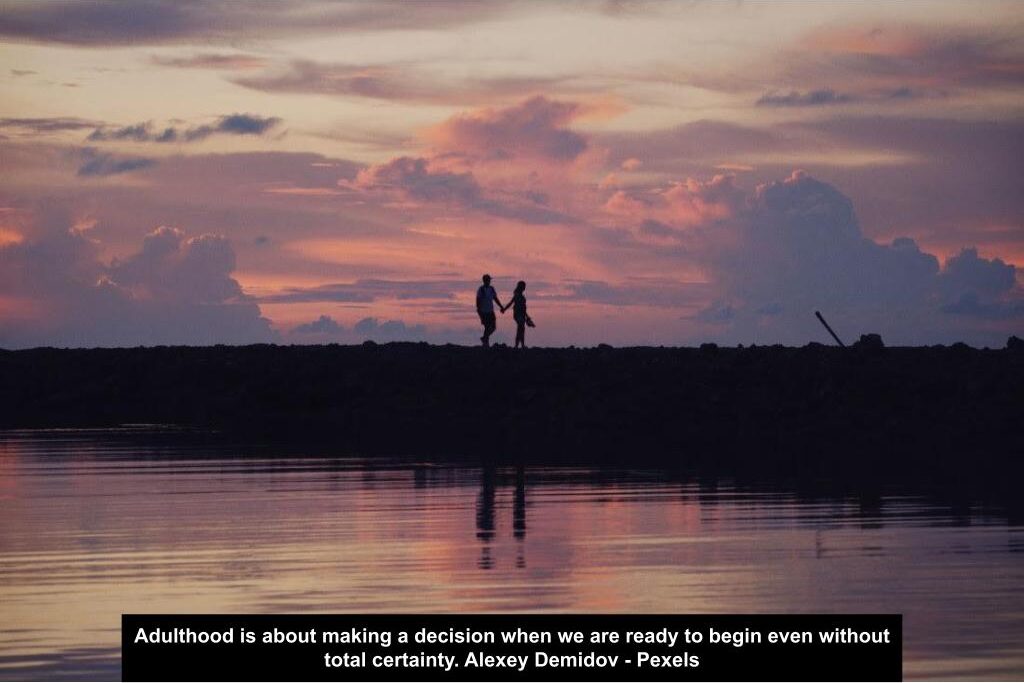
I sometimes think adulthood follows the same principle. The goal is not to eliminate every doubt before making a decision. I am no longer convinced that such a day ever comes. Some doubts are useful because they force us to think more carefully. Others simply remind us that we are standing at the beginning of something that has not yet had the chance to unfold.
We compare our careers with professions we never entered. We wonder whether another city might have suited us better, whether another house would have been a wiser investment, or whether another version of ourselves might somehow have lived a happier life. Without realising it, we continue mentally browsing possibilities long after we have already checked out.
Yet the best parts of life rarely reveal themselves on the day we make the decision. They arrive gradually, almost quietly, through ordinary mornings, unexpected friendships, family dinners, difficult conversations, new responsibilities and memories that no brochure, career guide or property website could ever have predicted. Looking back, those are rarely the things we considered before making the decision. And yet they often become the reasons we are grateful we made it.
Perhaps that is the quieter lesson adulthood has been trying to teach me all along. There comes a time when yesterday’s questions have already served their purpose. They helped us choose carefully, and for that we should be grateful.
After that, only life itself can provide the rest of the answers.

The author is a professor of biomedical engineering at the Faculty of Engineering, the Director of UM Press, and the Principal of Tuanku Bahiyah Residential College (KK2), Universiti Malaya
About The Author