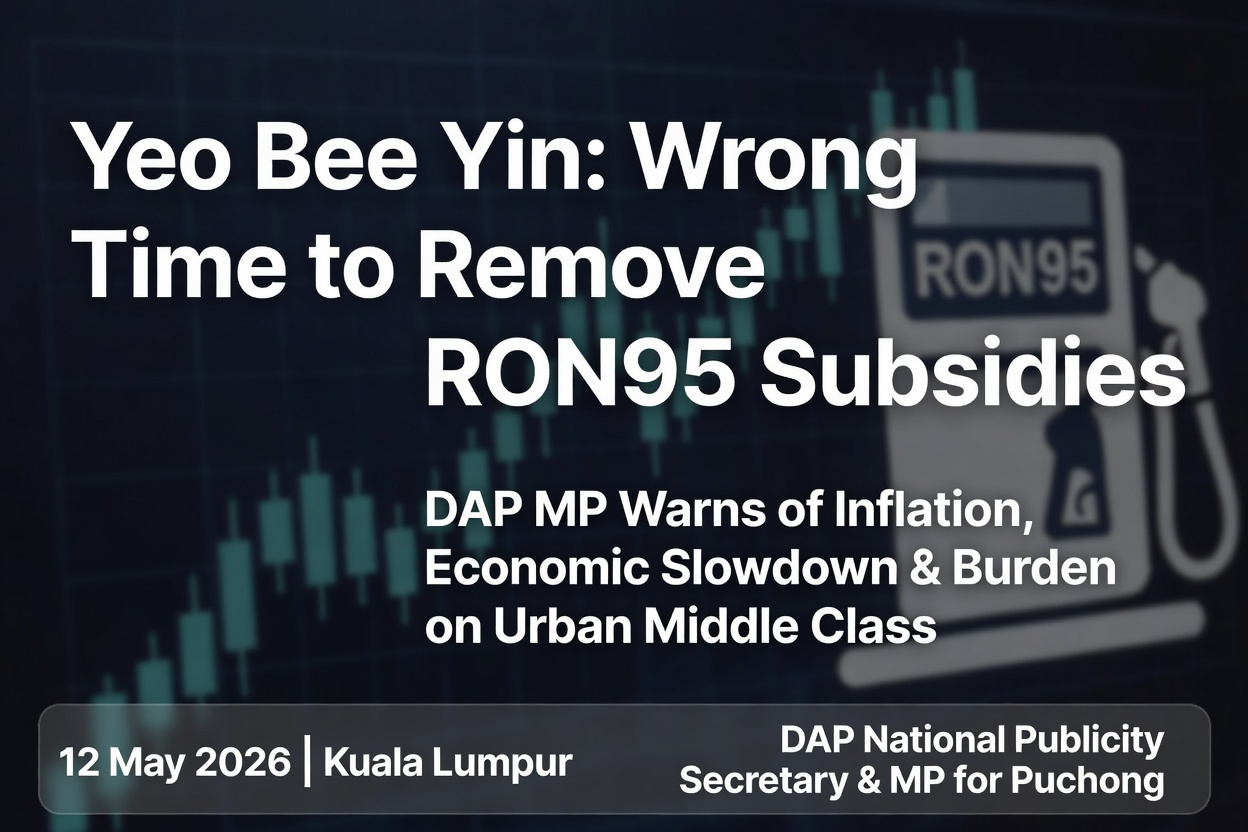
KUALA LUMPUR, May 12, 2026 – DAP National Publicity Secretary and Puchong MP Yeo Bee Yin today criticised the government’s plan to remove RON95 fuel subsidies for higher-income Malaysians, warning that it is poorly timed and risks triggering inflation and an economic slowdown.
In a media statement issued at DAP Headquarters, Yeo responded to Prime Minister Dato’ Seri Anwar Ibrahim’s recent announcement that the government has agreed in principle to remove RON95 (Budi 95) subsidies for the T15 and T20 income groups.
“Fuel price hikes are never contained within a single demographic; they ripple through the entire supply chain,” she said. Many within the T15/T20 categories are small business owners, service providers and employers. When their transportation and operational overheads rise, these costs are inevitably passed down to the consumer, ultimately hurting lower-income groups as well.
Yeo stressed that the T15/T20 group is a primary engine for domestic private consumption. Sharply increasing their fuel bills risks stifling demand in the retail, hospitality and service sectors, especially with the economy already burdened by the ongoing Middle East conflict.
She questioned the net economic impact of the policy, noting that the government is almost certain to introduce an economic stimulus package to navigate current global challenges.
“Is there truly a net positive impact on the economy when the government uses one hand to remove subsidies—effectively hiking the inflation and contracting demand—and the other to cushion the inflation and to stimulate demand through a supplementary budget?” Yeo asked.
She added that the worst time to remove any subsidy is in the middle of a crisis when an expansionary fiscal policy — not a contractionary one — is required to sustain the economy.
On the proposed targeting mechanism, Yeo described gross household income as a “blunt instrument” that fails to account for geographical cost-of-living disparities and specific household obligations.
“A household earning RM13,000 (roughly the T15 threshold) in a rural area may live comfortably; however, a dual-income professional couple in the Klang Valley earning that same amount — while supporting three children and elderly parents — is effectively the ‘struggling urban middle class’,” she explained.
If the T15 threshold is implemented, nearly one-third of households in Selangor and Kuala Lumpur, as well as 40% of households in Putrajaya, will be affected, she noted.
Yeo also warned of serious implementation challenges. Any system involving ID verification or tiered pricing risks creating massive bottlenecks and long queues at petrol stations, while a dual-pricing system could open new avenues for a “grey market” and corruption through the illegal resale of subsidised fuel.
In conclusion, Yeo urged the government not to rush the decision.
“The removal of RON95 subsidies has massive structural implications and must not be rushed. Putrajaya must prove with data that this move will not trigger an inflationary spiral or a net economic loss before asking the people to bear this burden,” she said.
“Fiscal reform should not become a code word for squeezing the urban middle class to their breaking point. All in all, we should be strengthening our economy in these volatile times, not creating a self-inflicted cost-of-living crisis.”
About The Author