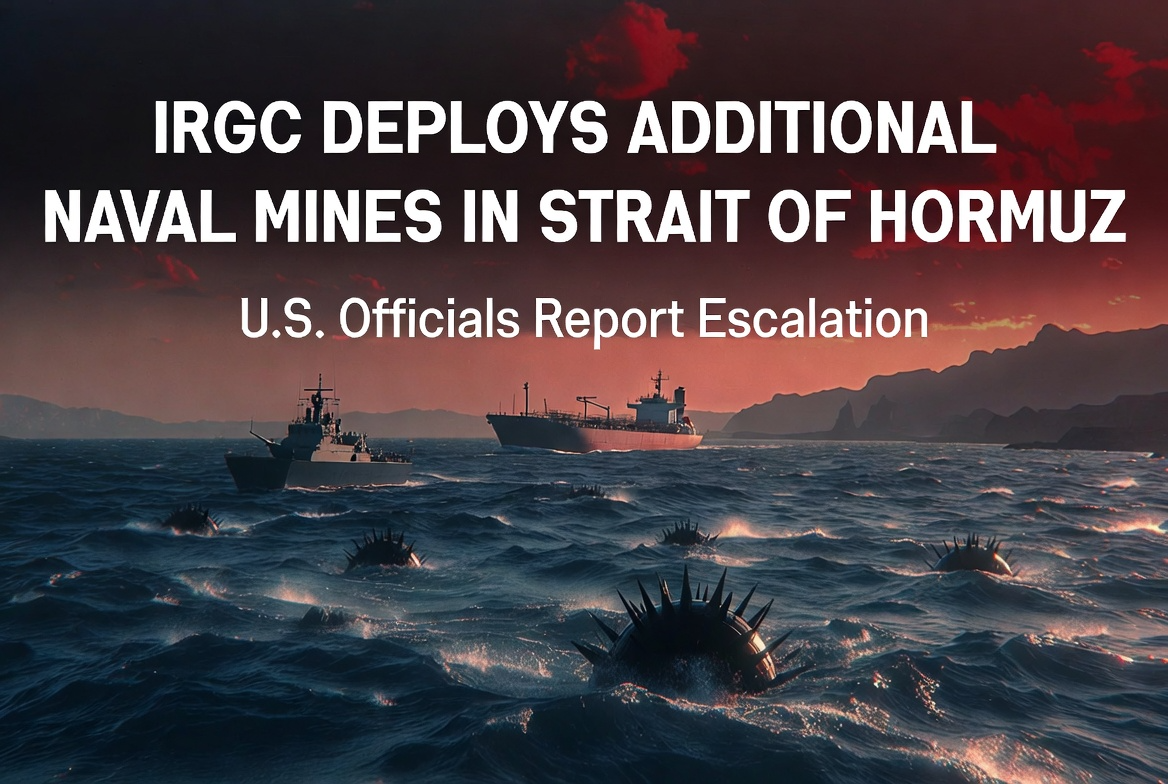
WASHINGTON D.C April 23, 2026 — Iran’s Islamic Revolutionary Guard Corps (IRGC) has planted more naval mines in the Strait of Hormuz this week, according to U.S. officials cited by Axios.
The development comes amid heightened tensions in the ongoing U.S.-Iran conflict, where the narrow waterway — through which roughly 20% of global oil and liquefied natural gas passes in peacetime — has been a flashpoint for months. Mines laid earlier in the conflict have already disrupted shipping, driven up energy prices, and complicated efforts to restore safe passage.
Axios, citing unnamed U.S. defense and intelligence officials, reported that the latest mine-laying activity was detected recently as Iran continues to assert control over the strategic chokepoint. The IRGC has previously used small fast boats to deploy mines, a tactic aimed at deterring commercial traffic and pressuring international actors involved in the broader regional standoff.
This marks a potential escalation in Iran’s maritime strategy. Earlier this year, Iran laid an estimated dozen or more mines in the strait during the initial phases of hostilities, according to U.S. and allied assessments. Some of those mines have drifted due to strong currents, making clearance operations complex and time-consuming. Pentagon officials have estimated it could take up to six months to fully clear the area.
The U.S. military has been actively countering the threat. In recent weeks, American warships, including guided-missile destroyers, have transited the strait as part of mine-clearance missions. President Trump has publicly stated that U.S. forces have destroyed numerous Iranian mine-laying vessels and ordered the Navy to “shoot and kill” any small boats attempting to deploy more mines.
Iran has not officially confirmed the latest deployment but has maintained that any mines present are for defensive purposes and has directed commercial shipping to follow specific routes it designates to avoid hazards. Tehran has also accused the U.S. and its allies of violating maritime norms through blockades and military operations in the Persian Gulf.
The Strait of Hormuz remains effectively restricted for much of the world’s tanker traffic, contributing to volatility in global energy markets. Shipping companies have rerouted vessels, purchased higher war-risk insurance, or halted transits altogether.
No immediate U.S. military response to the reported new mines has been announced, but officials in Washington are monitoring the situation closely. The White House has held multiple Situation Room meetings on the Hormuz crisis in recent days, involving senior figures including Secretary of State Marco Rubio and Vice President JD Vance.
This latest report underscores the fragile state of maritime security in one of the world’s most critical energy arteries, even as diplomatic efforts for a ceasefire continue behind the scenes.
Life News Agency will continue to monitor developments in the Strait of Hormuz and provide updates as more information becomes available.
About The Author