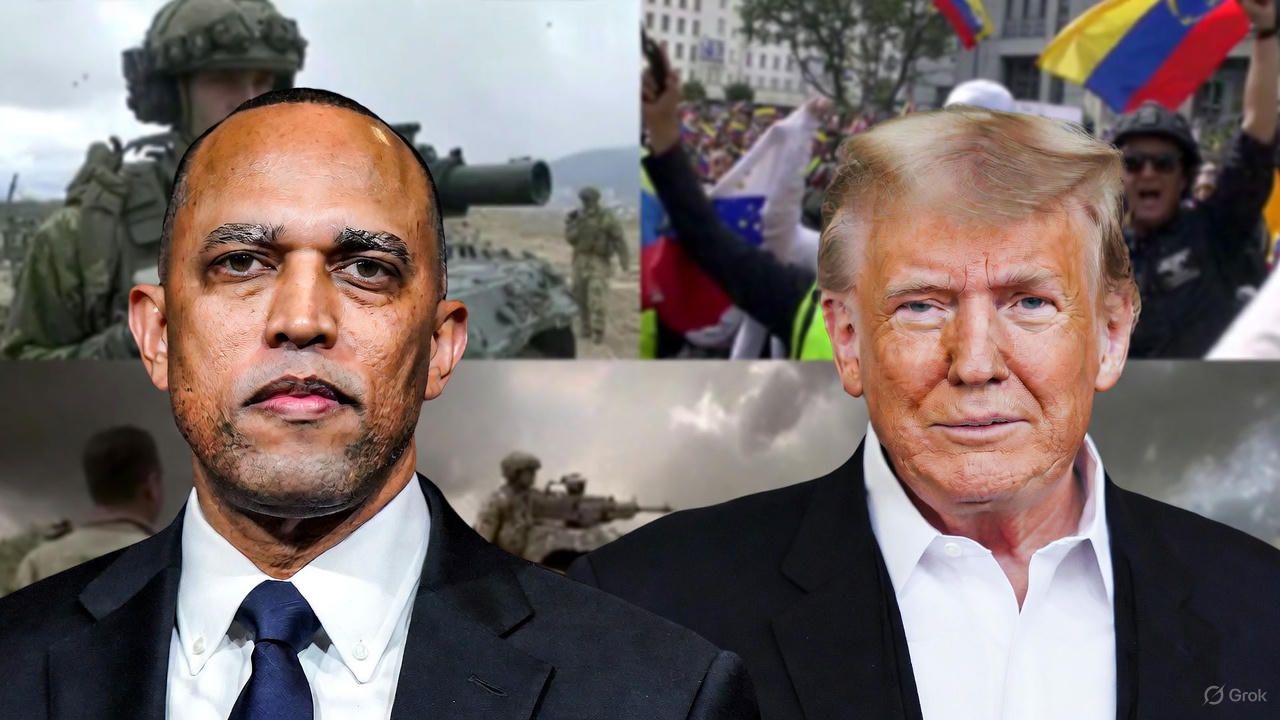
WASHINGTON, D.C. January 3, 2026 – In the wake of a dramatic U.S. military strike on Venezuela that resulted in the capture of President Nicolás Maduro, House Democratic Leader Hakeem Jeffries issued a sharp rebuke of the Trump administration’s actions, calling them unconstitutional and a potential repeat of past foreign policy failures
Jeffries, in a statement posted on X (formerly Twitter) on January 3, described Maduro as a “criminal and authoritarian dictator” who has oppressed Venezuelans for years and lacks legitimacy as head of government. He emphasized that the Venezuelan people deserve better amid the breakdown of rule of law and democracy in the country. However, Jeffries pivoted to criticize President Donald Trump, asserting that Trump has a “constitutional responsibility to follow the law and protect democratic norms in the United States.”
The Democratic leader accused the administration of failing to seek congressional authorization for the use of military force and not properly notifying Congress in advance of the operation. “The promotion of security and stability in a region requires more than just military force as we painfully discovered in Iraq and Afghanistan,” Jeffries warned, drawing parallels to previous U.S. interventions.
The operation, announced by Trump early on January 3, involved a “large-scale strike” on Venezuelan targets, culminating in the capture of Maduro and his wife, Cilia Flores, by U.S. special forces, specifically the Army’s Delta Force unit. Trump, speaking at a press conference from his Mar-a-Lago resort in Florida, stated that the U.S. would “run the country” temporarily until a “safe, proper, and judicious transition” to new leadership could occur. He described the assault as “spectacular” and aimed at bringing the “dictator Maduro to justice,” with the captured leaders set to face narcoterrorism charges in New York.
The strike followed months of escalating tensions, including U.S. naval buildups in the region and strikes on alleged drug-smuggling vessels. Venezuelan officials reported casualties from the attack, though exact figures remain unclear. In Venezuela, opposition leader María Corina Machado celebrated the event as the “hour of freedom,” while crowds in Caracas and expatriate communities in places like Miami and Doral, Florida, erupted in celebrations.
Internationally, reactions were mixed and often critical. UN Secretary-General António Guterres expressed deep alarm, stating that the U.S. actions “constitute a dangerous precedent.” China condemned the strike, and Colombia deployed forces to its border amid concerns over a potential refugee influx. Trump escalated rhetoric toward Colombian President Gustavo Petro, warning him to “watch his ass.”
Domestically, Jeffries’ statement drew polarized responses on X. Supporters of the operation, including some Republican users, dismissed his concerns, arguing that the extraction did not require congressional approval and would enhance U.S. security by disrupting cartels. Critics, however, called for impeachment and referral to the International Criminal Court, labeling the move as an act of aggression.
Legal experts, such as constitutional scholar Jonathan Turley, have noted that while the operation raises questions under the War Powers Resolution, presidents have historically conducted limited strikes without prior authorization. The White House has not yet responded directly to Jeffries’ criticisms, but Trump praised the mission as a success in protecting American interests.
As Maduro and Flores are en route to face charges in the U.S., the incident marks the most significant American intervention in Latin America since the 1989 invasion of Panama. Congressional Democrats are expected to push for hearings, while the administration focuses on stabilizing Venezuela under interim U.S. oversight.
About The Author