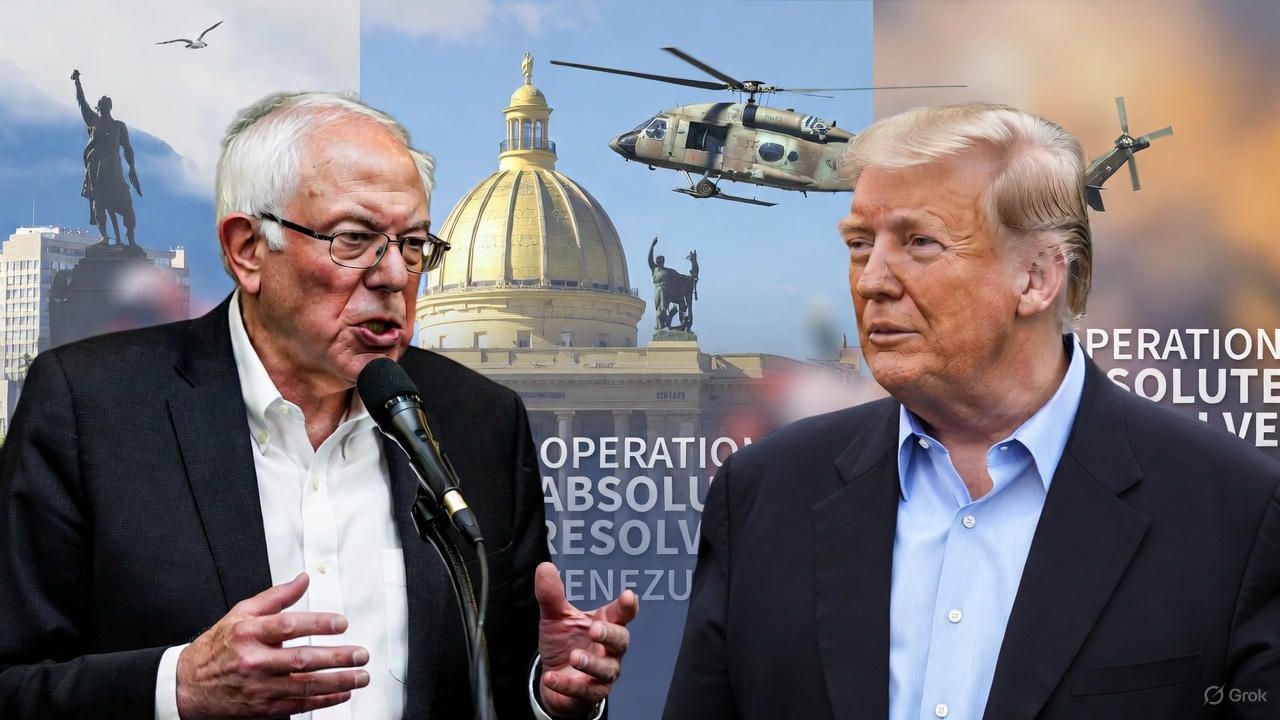
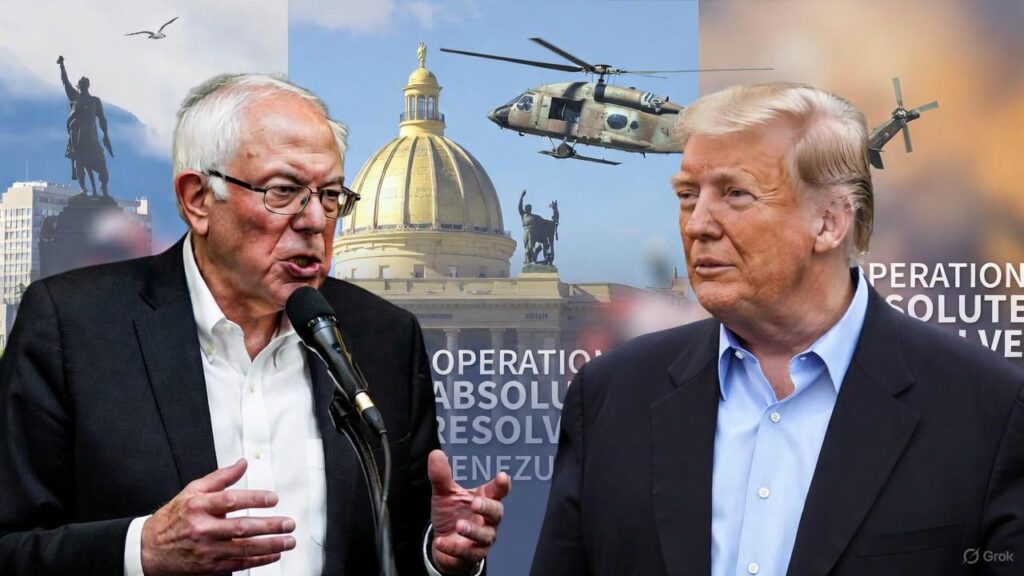
WASHINGTON, D.C. January 3, 2026 – Senator Bernie Sanders (I-Vt.) issued a scathing statement on Saturday criticizing President Donald Trump’s military operation in Venezuela, which resulted in the capture of Venezuelan President Nicolás Maduro and his wife, Cilia Flores. Sanders described the action as a “brazen violation of international law” and an unconstitutional overreach by the executive branch, urging Congress to immediately pass a War Powers Resolution to halt further U.S. involvement.
In his statement posted on X, Sanders argued that the president lacks the authority to unilaterally take the nation to war, even against a “corrupt and brutal dictator like Maduro.” He emphasized that Trump’s declaration that the U.S. would “run” Venezuela temporarily echoes imperialistic policies from darker chapters of American history in Latin America, such as interventions that have left “a terrible legacy.” Sanders linked the move to a revival of the Monroe Doctrine, claiming it positions the U.S. to dominate hemispheric affairs and control Venezuela’s vast oil reserves, the largest in the world.
“Trump’s attack on Venezuela will make the United States and the world less safe,” Sanders wrote. “This is the horrific logic of force that Putin used to justify his brutal attack on Ukraine.” He contrasted this with Trump’s “America First” campaign promises, accusing the president of neglecting domestic crises like healthcare collapse, paycheck-to-paycheck living for 60% of Americans, and housing affordability in favor of “military adventurism abroad.”
The operation, codenamed “Absolute Resolve,” involved U.S. airstrikes on multiple targets in northern Venezuela, including military facilities in Caracas, early Saturday morning local time. President Trump announced the strikes and Maduro’s capture via Truth Social, later holding a press conference at Mar-a-Lago where he stated the U.S. would govern Venezuela “until such time as we can do a safe, proper and judicious transition.” Trump praised the mission as a “brilliant operation” executed by the U.S. Army’s Delta Force, with no American fatalities reported, though some troops were injured. U.S. Attorney General Pam Bondi confirmed Maduro and Flores would face narcoterrorism charges in the U.S.
The action followed months of escalating tensions and U.S. military buildup in the region, framed by the Trump administration as a response to Maduro’s alleged drug trafficking and misrule. Venezuelan Vice President Delcy Rodríguez demanded “proof of life” for Maduro, labeling his absence a “disappearance.” Casualties from the strikes remain unknown, but explosions were reported in Caracas.
Sanders’ criticism echoes concerns from human rights organizations like the Washington Office on Latin America (WOLA), which called the intervention a violation of international law and U.S. constitutional limits on presidential war powers, warning it sets a “dangerous precedent.” Senate Majority Leader John Thune (R-S.D.) praised the operation as a “necessary action” to disrupt drug cartels killing Americans, expressing gratitude to U.S. forces and anticipating further briefings.
International reactions were sharply divided. Cuba and Mexico condemned the strikes as a “criminal attack,” while Argentina’s President Javier Milei hailed it with “long live freedom.” Colombia warned of potential regional fallout, and leaders from Russia and China are expected to respond amid their alliances with Maduro. In Caracas, some residents expressed mixed feelings in brief interviews, with one calling it a “new beginning” and another fearing instability. Venezuelans in exile, such as those in Miami, celebrated the news.
The intervention marks the most significant U.S. military action in Latin America since the 1989 Panama invasion, raising questions about Trump’s foreign policy in his second term. As Congress reconvenes, calls for oversight are mounting, with Sanders’ statement amplifying demands for accountability.
About The Author