
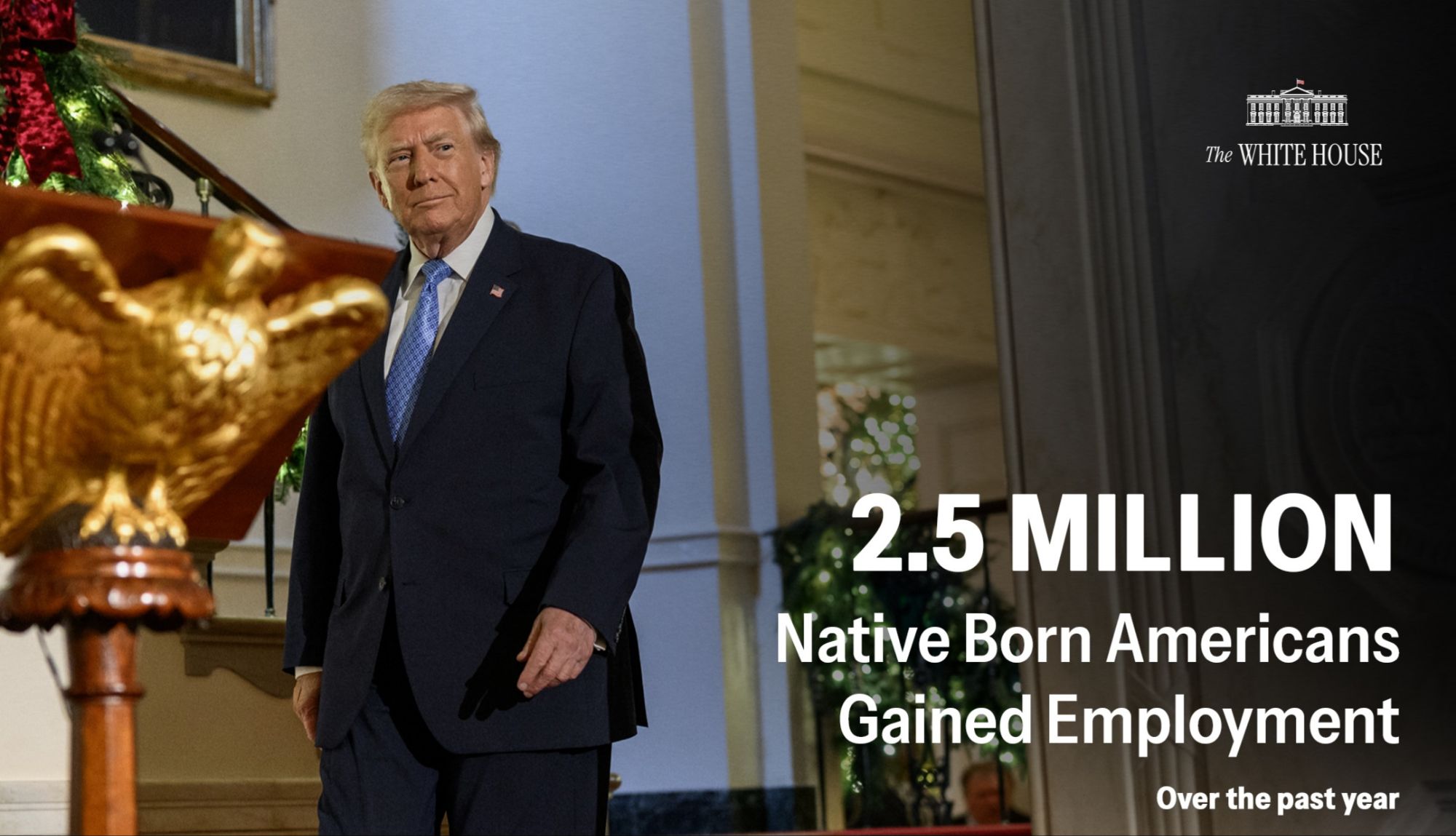
WASHINGTON, D.C. January 2, 2026 – The Trump administration highlighted what it described as a significant shift in the U.S. job market, claiming that 2.5 million native-born Americans gained employment over the past year while 670,000 foreign-born workers lost jobs. The assertion, posted on the official White House X account on January 2, came with a graphic featuring President Donald Trump and data attributed to the Bureau of Labor Statistics (BLS).
In the post, the White House stated: “Don’t believe the fake news lies. The Trump administration is driving positive change for AMERICAN workers.” The accompanying image contrasted two photos of Trump—one in a formal setting with the positive native-born figure, and another outdoors pointing forward with the foreign-born loss statistic. The data purportedly covers the period from December 2024 to December 2025, aligning with BLS reports on employment by nativity.
BLS data from Table A-7 of the Employment Situation report, which tracks civilian employment by nativity, shows fluctuations in these categories. For instance, from January to November 2025, native-born employment rose by approximately 2.7 million, while foreign-born employment declined by 972,000, according to unadjusted figures. These numbers have been cited by the administration as evidence of policies prioritizing American workers, though the White House graphic uses slightly lower figures, possibly reflecting a specific 12-month window or seasonal adjustments.
However, economists and analysts have cautioned that these statistics may be misleading due to methodological issues in how BLS incorporates population estimates. The figures rely on predetermined 2025 population controls from the Census Bureau, calculated in 2024, which overestimate native-born population growth by over 5 million—a figure deemed implausible by experts. This inflation creates the appearance of outsized employment gains for native-born workers, even as overall job creation has stalled.
Federal Reserve Chair Jerome Powell noted in a December 2025 press conference that actual job growth for the year was likely lower than reported, with revisions expected in the January 2026 benchmark update. Adjusted estimates suggest net job additions of only about 187,000 from January to November 2025, far below the household survey’s implied totals. This discrepancy arises from differences between the Current Population Survey (CPS), which tracks nativity, and the Current Employment Statistics (CES) survey, which measures total payrolls.
Critics argue the data does not support claims of a booming native-born job market under Trump. The unemployment rate for native-born Americans rose from 3.8% in November 2024 to 4.3% in November 2025, indicating weakening conditions rather than improvement.Monthly job growth slowed markedly after Trump’s inauguration, dropping from 256,000 in December 2024 (under President Biden) to averages below 100,000 in the latter half of 2025. Layoffs surpassed 1.17 million for the year, the highest since 2020, with federal government employment down by 317,000.
The foreign-born employment decline has been linked to reduced immigration and workforce exits, with CPS data showing a drop of about 1.1 million foreign-born workers from the labor supply in 2025. Yet, there is no aggregate evidence that this translated to more jobs for native-born workers; instead, it may reflect broader labor market contraction. Analysts like Dean Baker from the Center for Economic and Policy Research have pointed out that the native-born gains are an artifact of overstated population growth, not genuine economic shifts.
The White House post garnered over 108,000 views and mixed reactions on X, with supporters praising the focus on American workers and detractors questioning the data’s validity or sharing edited memes. Replies included accusations of “Zionist lies” and altered graphics slimming Trump’s image for humor. The administration has not responded to requests for comment on the criticisms.
As the BLS prepares its annual benchmark revisions, expected with the January 2026 report, further clarity on 2025’s labor dynamics may emerge. For now, the debate underscores ongoing tensions over immigration, economic policy, and data interpretation in a polarized landscape.
About The Author