PARIS/BERLIN March 2, 2026 – French President Emmanuel Macron and German Chancellor Friedrich Merz have announced the creation of a high-ranking bilateral nuclear steering group to deepen cooperation on strategic deterrence, marking a significant step in Franco-German defence integration.
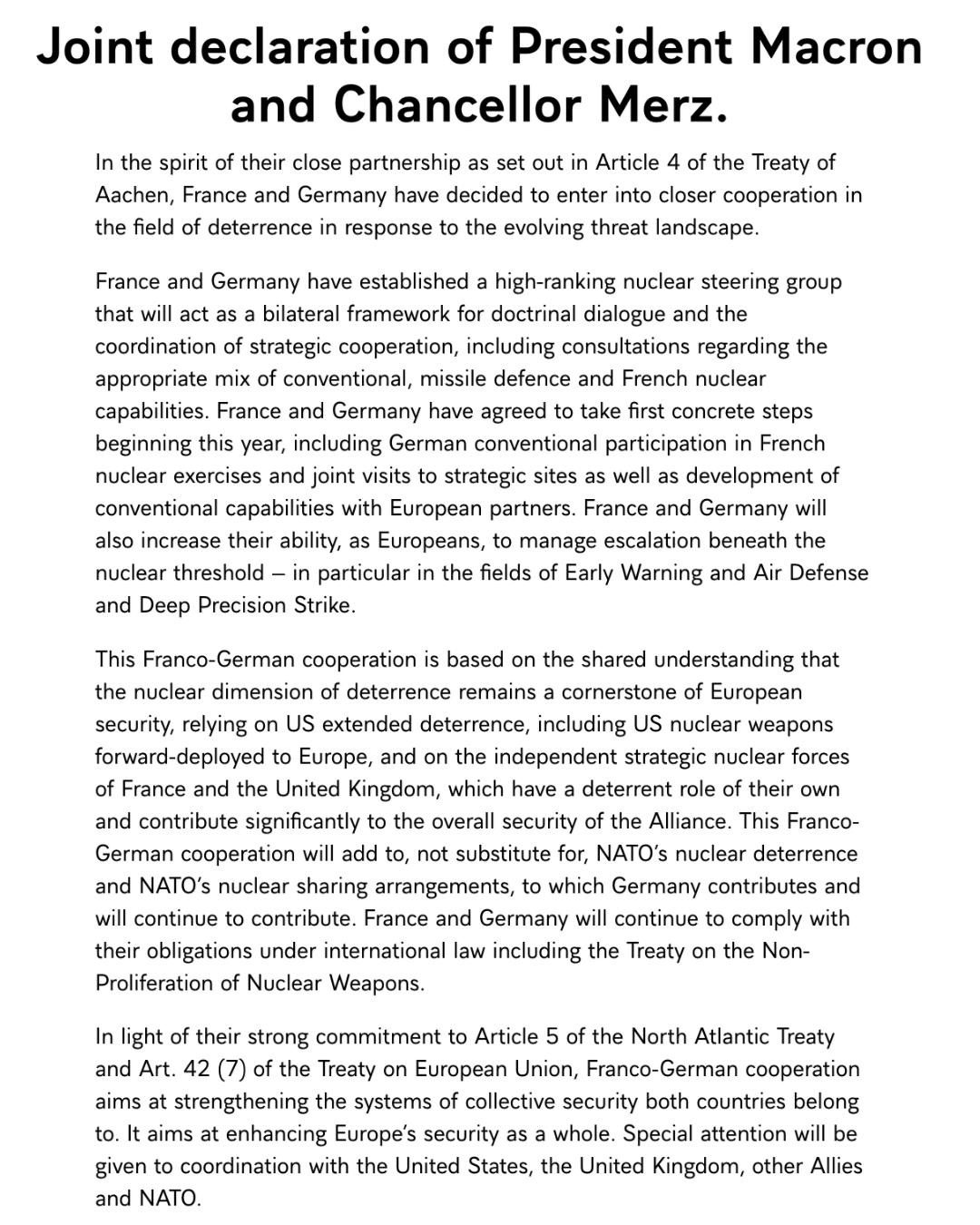
In the joint declaration, released on Monday, the two leaders emphasised their “close partnership as set out in Article 4 of the Treaty of Aachen” and committed to closer coordination “in response to the evolving threat landscape.”
The agreement includes the immediate establishment of a high-ranking nuclear steering group that will serve as a bilateral framework for doctrinal dialogue and strategic cooperation. This encompasses consultations on the appropriate mix of conventional forces, missile defence, and French nuclear capabilities.
Concrete steps will begin this year, including:
– Participation of German conventional forces in French nuclear exercises
– Joint visits to strategic sites
– Development of conventional capabilities with European partners
– Enhanced ability to manage escalation below the nuclear threshold, particularly in early warning, air defence, and deep precision strike
The declaration explicitly states that this Franco-German cooperation “will add to, not substitute for, NATO’s nuclear deterrence and NATO’s nuclear sharing arrangements, to which Germany contributes and will continue to contribute.” It reaffirms reliance on U.S. extended deterrence — including forward-deployed U.S. nuclear weapons in Europe — alongside the independent strategic nuclear forces of France and the United Kingdom.
Both countries pledged full compliance with international law, including the Treaty on the Non-Proliferation of Nuclear Weapons.
“In light of their strong commitment to Article 5 of the North Atlantic Treaty and Art. 42 (7) of the Treaty on European Union, Franco-German cooperation aims at strengthening the systems of collective security both countries belong to,” the statement reads. “It aims at enhancing Europe’s security as a whole. Special attention will be given to coordination with the United States, the United Kingdom, other Allies and NATO.”
The announcement was highlighted by the Embassy of France in the United States on X (formerly Twitter), where the full text of the declaration was shared.
The move comes amid heightened European security concerns and coincides with President Macron’s recent address at a French nuclear submarine base in Brittany, where he outlined plans to expand France’s nuclear arsenal and increase strategic dialogue with European partners.
Analysts describe the initiative as a historic evolution in European defence policy, strengthening collective deterrence without Germany developing its own nuclear weapons. It is expected to pave the way for broader European coordination while maintaining close ties with NATO and the United States.
About The Author