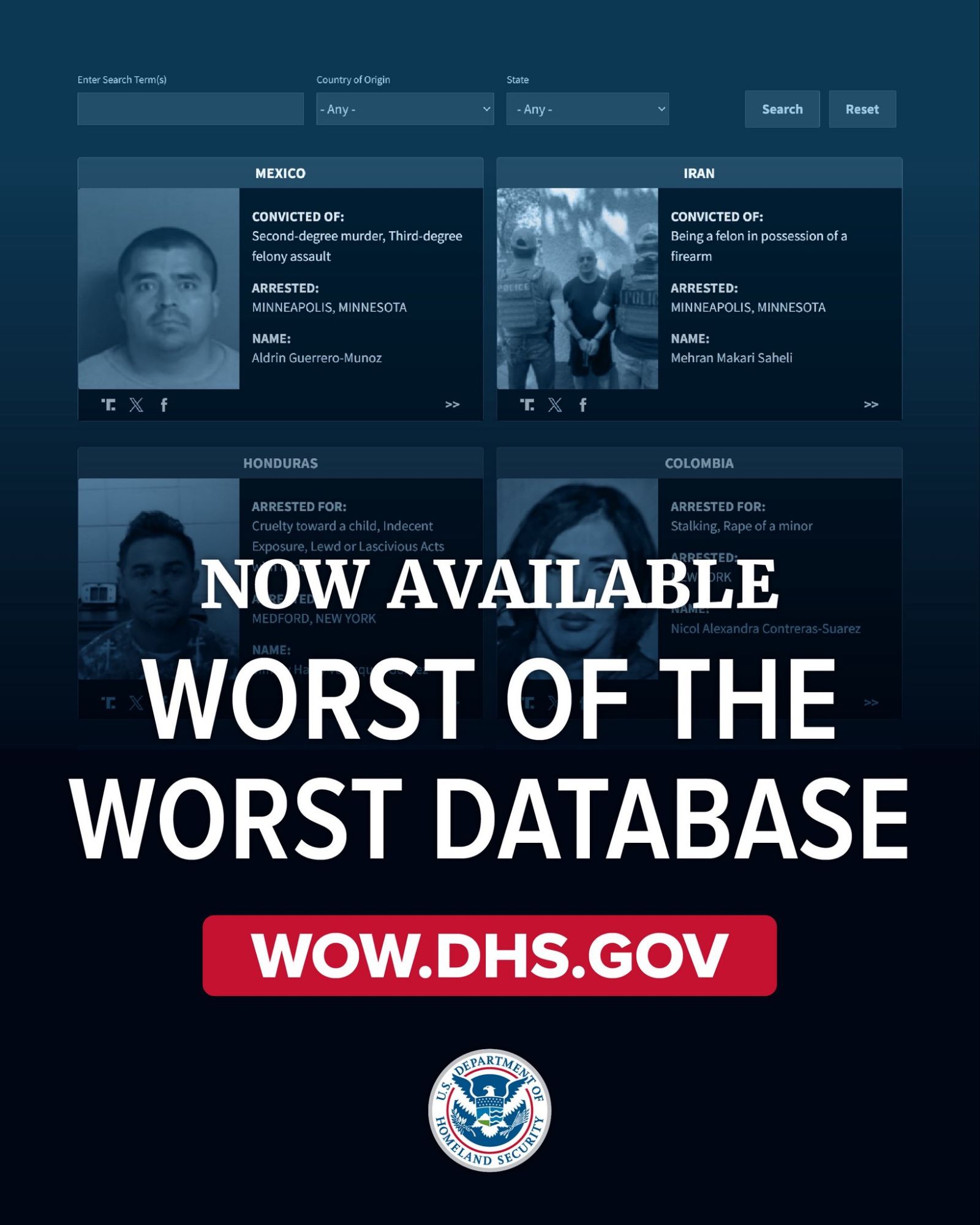
WASHINGTON, D.C. December 8, 2025.– In a bold move toward greater government accountability, the Department of Homeland Security (DHS) unveiled a new online tool on Monday designed to expose the most dangerous criminal aliens removed from U.S. communities. Dubbed the “Worst of the Worst” database, the platform—accessible at wow.dhs.gov—allows Americans to search and view detailed profiles of individuals arrested and deported by U.S. Immigration and Customs Enforcement (ICE) for heinous crimes.
The initiative, announced via an official X post from @DHSgov, emphasizes transparency in the ongoing mass deportation efforts under the current administration. “Find the WORST OF THE WORST removed from your community,” the post reads. “With this transparent tool, Americans can see for themselves what public safety threats were lurking in their neighborhoods and communities.” The announcement has already garnered over 3,500 likes and 1,100 reposts on X, sparking widespread praise for its no-holds-barred approach to public safety.
A Searchable Gallery of Removed Threats
The database features an intuitive search interface where users can filter by name, country of origin, or U.S. state. Profiles include mugshots, conviction details, and arrest locations, drawing from ICE’s enforcement actions. While exact totals aren’t yet publicized, the site highlights a diverse roster of offenders from nations including Mexico, Iran, Honduras, Colombia, Egypt, and Senegal.
Early spotlights include:
– Aldrin Guerrero-Munoz, a Mexican national convicted of second-degree murder and third-degree felony assault, arrested in Minneapolis, Minnesota.
– Mehran Makari Saheli, from Iran, convicted as a felon in possession of a firearm, also apprehended in Minneapolis.
– Jimmy Harry Velasquez Gomez, a Honduran migrant arrested in Medford, New York, for child cruelty, indecent exposure, and lewd or lascivious acts with a minor.
– Nicol Alexandra Contreras-Suarez, originally from Colombia, charged with stalking and rape of a minor in New York City.
Additional featured cases span aggravated assault and robbery in Philadelphia (Yehia Elham Badawi, Egypt), illegal re-entry and weapon offenses in Texas and Arizona, and drug possession and burglary in Colorado and California. Crimes range from violent felonies like murder and sexual assault to drug trafficking and domestic violence, underscoring the site’s focus on high-risk individuals.
DHS officials described the tool as a direct response to public demands for visibility into immigration enforcement. “This isn’t just about removals—it’s about restoring trust by showing results,” a DHS spokesperson stated in the announcement. The database links to related news articles and court proceedings, enabling users to dig deeper into each case.
Public Reaction: Cheers, Calls for More, and a Push for Interactive Features
The launch has ignited fervent discussion on X, with users hailing it as a long-overdue step in the fight against crime linked to illegal immigration. “This is awesome! This administration has been by far the most transparent administration of my lifetime,” tweeted @CALI4AZ, echoing sentiments from thousands of supporters.
Others suggested enhancements, like an interactive map to visualize arrest hotspots. “Add an interactive map showing where they were arrested/lived/worked. People need to see where these illegals are,” posted @RdPillsRbtHoles. Rural communities, in particular, voiced relief; one user from White Deer, Pennsylvania, lamented how such threats were “dropped off” in small towns under prior policies.
Calls for high-profile additions flooded replies, including demands to investigate figures like Reps. Ilhan Omar and Rashida Tlaib for alleged immigration irregularities. Personal stories emerged too: “Thank you for removing the pedophile two blocks away from me last month!” shared @BiospiritWest, crediting recent ICE actions.
Critics, however, questioned enforcement gaps. Immigration attorney insights shared on X highlighted that visa revocations don’t always trigger immediate deportation, allowing some to “remain lawfully in the U.S.” amid appeals—a frustration echoed in cities like San Francisco, where local lists of offenders circulate informally.
Broader Context: A Surge in Deportations
This tool arrives amid a reported uptick in ICE operations, aligning with the administration’s pledge to prioritize public safety. DHS data shows a focus on “the worst of the worst”—repeat offenders and violent criminals—who represent a fraction of broader removals but pose outsized risks. By making this information public, the database not only informs but also deters, signaling that no community is off-limits for accountability.
As one X user put it: “DEPORT ALL ILLEGAL ALIENS. DO YOUR DAMN JOB.” With wow.dhs.gov now live, DHS is betting that sunlight is the best disinfectant. For more, visit the site or follow @DHSgov for updates.
About The Author