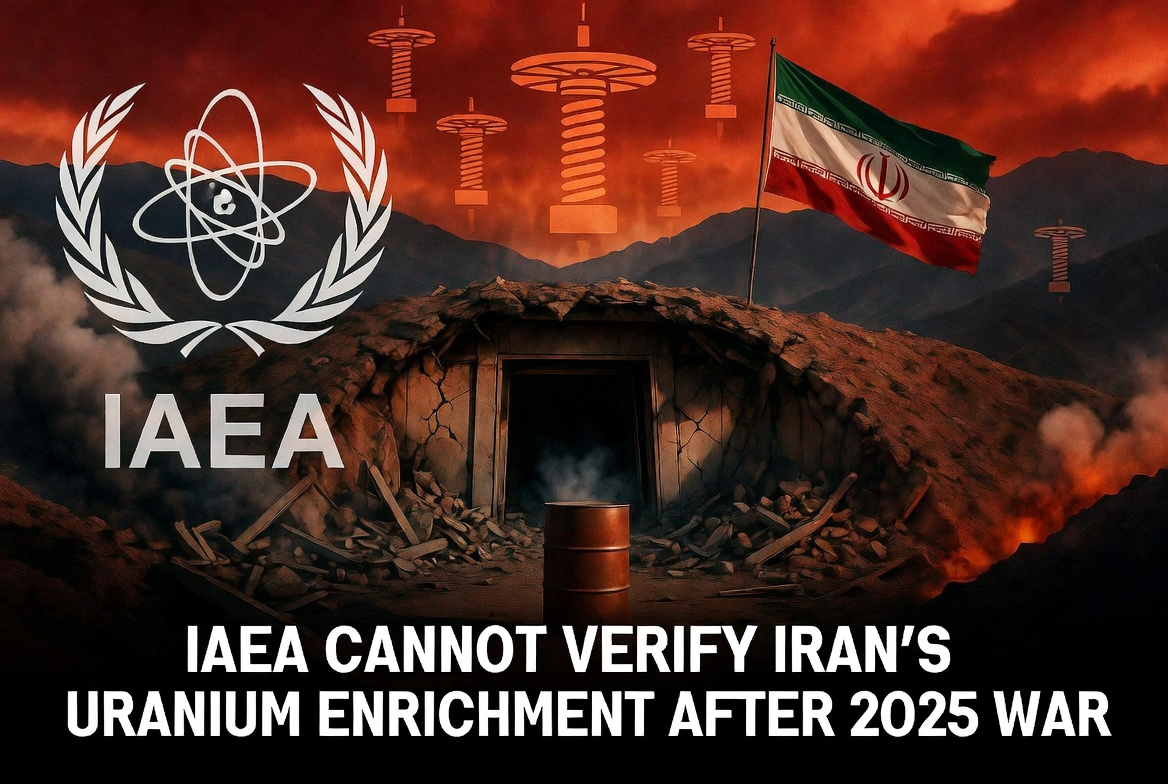
VIENNA, June 5, 2026 — The International Atomic Energy Agency (IAEA) has stated it cannot confirm whether Iran has resumed uranium enrichment activities following last year’s military strikes on its nuclear facilities, according to a report that continues to fuel international concerns over Tehran’s nuclear program.
In its latest assessment circulated to member states, the UN nuclear watchdog highlighted a complete loss of continuity regarding Iran’s pre-war stockpile of enriched uranium, particularly material enriched to near-weapons-grade levels of 60% U-235. The agency has had no access to key damaged sites since the June 2025 conflict.
During the 12-day war in June 2025, the United States and Israel conducted airstrikes on Iran’s primary nuclear facilities under operations including “Midnight Hammer.” Targets included:
- Natanz: The Pilot Fuel Enrichment Plant suffered severe damage to above-ground structures, with potential underground impacts from bunker-buster munitions.
- Fordow: The deeply buried enrichment site in a mountain was hit but its full extent of damage remains difficult to assess.
- Esfahan (Isfahan): The Nuclear Technology Center, including tunnel complexes used for storing enriched uranium, was targeted with cruise missiles and suffered significant destruction to conversion and processing facilities.
Prior to the strikes, Iran possessed approximately 440.9 kg of uranium enriched up to 60% — enough, if further processed, for multiple nuclear weapons according to IAEA benchmarks — along with a total enriched uranium stockpile exceeding 9,800 kg.
The February 2026 IAEA report (GOV/2026/8) and subsequent updates emphasize:
- No access to the affected facilities for verification.
- Inability to confirm the current size, composition, or location of Iran’s enriched uranium stockpile.
- Observations via satellite imagery of vehicular activity and other movements at Natanz, Fordow, and Esfahan entrances, but no confirmation of the purpose (e.g., recovery, reconstruction, or new activities).
IAEA Director General Rafael Grossi has repeatedly urged Iran to grant full inspector access, stressing that without it, the agency cannot provide assurances that Iran’s nuclear program remains exclusively peaceful. Iran maintains its program is for civilian energy purposes and has claimed much of the material is buried under rubble from the strikes.
The issue comes amid heightened tensions. Iran, a BRICS member, suspended full cooperation with the IAEA after the 2025 strikes. Diplomatic efforts, including planned meetings, have yielded limited progress. Western powers (US, UK, France, Germany) continue to press for transparency, while concerns persist over potential covert reconstitution of capabilities.
No evidence of resumed large-scale enrichment has been publicly confirmed by the IAEA, but the verification gap raises proliferation risks. Analysts note that even partial recovery of the pre-war stockpile could significantly shorten any potential “breakout” timeline.
This situation remains fluid, with the IAEA Board of Governors monitoring developments closely. Further updates are expected as diplomatic engagements continue.
About The Author