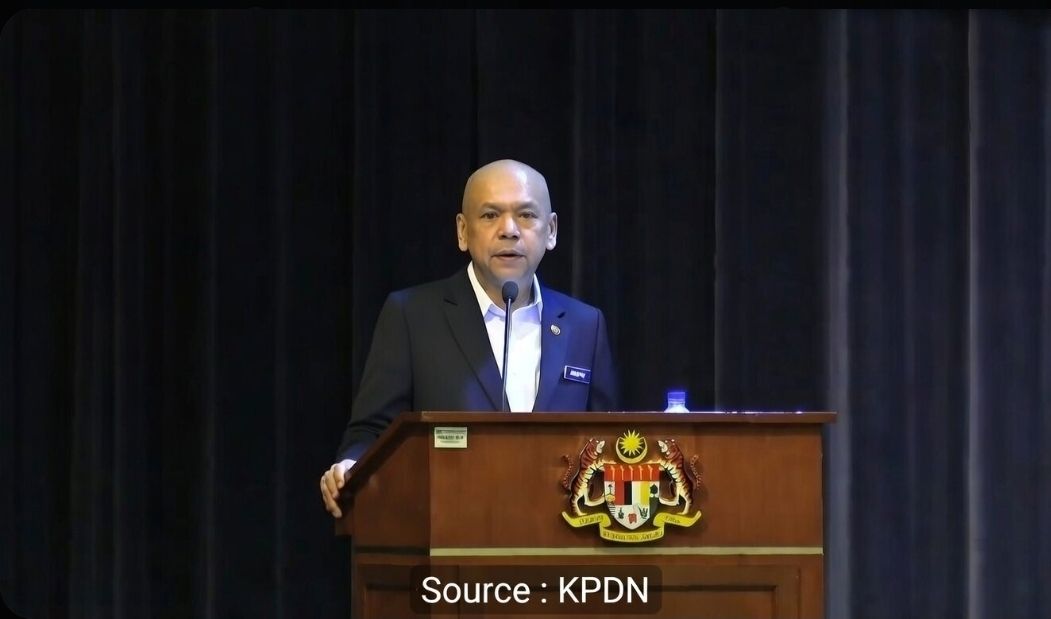
PUTRAJAYA, MALAYSIA January 21, 2026 – The Ministry of Domestic Trade and Cost of Living (KPDN) today outlined its strategic priorities for 2026, emphasizing a shift from policy planning to actionable implementation and measurable outcomes that directly benefit the public. In his annual address at the ministry’s assembly, Minister Datuk Armizan Mohd Ali highlighted the theme “K.P.D.N. K.I.T.A.: Memaknai Aspirasi Rakyat,” underscoring the need to translate aspirations into real-world results.
The event, attended by senior ministry officials, staff, and representatives from headquarters, state, and branch levels, served as both a reflection on 2025 achievements and a roadmap for the year ahead. Minister Armizan stressed the continuation of the ministry’s overarching Hala Tuju framework, introduced in 2024, which encompasses four key pillars: Enhancing Enforcement Agility, Driving Domestic Economic Growth, Empowering Consumer Advocacy and Resilience, and Adopting a Whole-of-Nation Approach to Cost of Living (NACCOL).
These pillars are propelled by the K.I.T.A. enablers: Government Inclusivity and Organizational Excellence, Industry Commitment, Governance Resolve, and Public Aspiration and Participation. For 2026, the ministry’s efforts will center on three indicators: converting blueprints (policies, strategic plans, and budgets) into footprints (initiatives, programs, and enforcement actions), ultimately yielding imprints (performance metrics, price stability, and public participation).
“This is not just about hearing plans; it’s about seeing and feeling the benefits,” Minister Armizan stated in his address. He noted that while 2026 marks the first year of the 13th Malaysia Plan (RMK-13), it is the fourth year under the MADANI government, making it crucial to accelerate implementation for sustainable domestic economic development.
A major highlight of the announcement was KPDN’s commitment to legal and institutional reforms to strengthen its functions. Building on the 2025 amendments to the Hire-Purchase Act, which improved consumer protections in financing agreements, the ministry plans to target five key clusters in 2026:
1. Amendments to the Competition Act 2010 and Competition Commission Act 2010 : These changes aim to bolster investigation and enforcement powers, enabling the Malaysia Competition Commission (MyCC) to more effectively combat cartels and monopolies for a fairer market.
2. Amendments to the Direct Sales and Anti-Pyramid Scheme Act 1993 : Focused on tightening regulations on direct selling and high-risk investment schemes to protect consumers from fraud while promoting ethical industry growth.
3. E-Commerce Legislation under the Electronic Transactions Act 2006 : Introducing or enhancing laws to address digital transaction challenges, including platform accountability and consumer safeguards in online trade.
4. Lemon Law Provisions under the Consumer Protection Act 1999 : Strengthening existing rules with detailed dispute resolution mechanisms, particularly for new vehicle claims, to ensure fair compensation.
5. Secured Transactions Law for Movable Property : Establishing a registration system for security interests in movable assets (tangible or intangible) to facilitate business financing, providing clarity and security for lenders via a voluntary registry overseen by the Companies Commission of Malaysia (SSM).
These reforms stem from studies initiated in 2024, incorporating feedback from industry players, related agencies, consumer associations, NGOs, and academics. Minister Armizan emphasized that the changes go beyond mere amendments, aiming to deliver tangible benefits that foster a healthy, sustainable, and progressive domestic economy.
As Malaysia navigates post-pandemic recovery and global economic pressures, KPDN’s 2026 agenda positions the ministry as a key driver in realizing public aspirations through effective governance and consumer-centric policies. The full address is available on the ministry’s official channels.
About The Author